


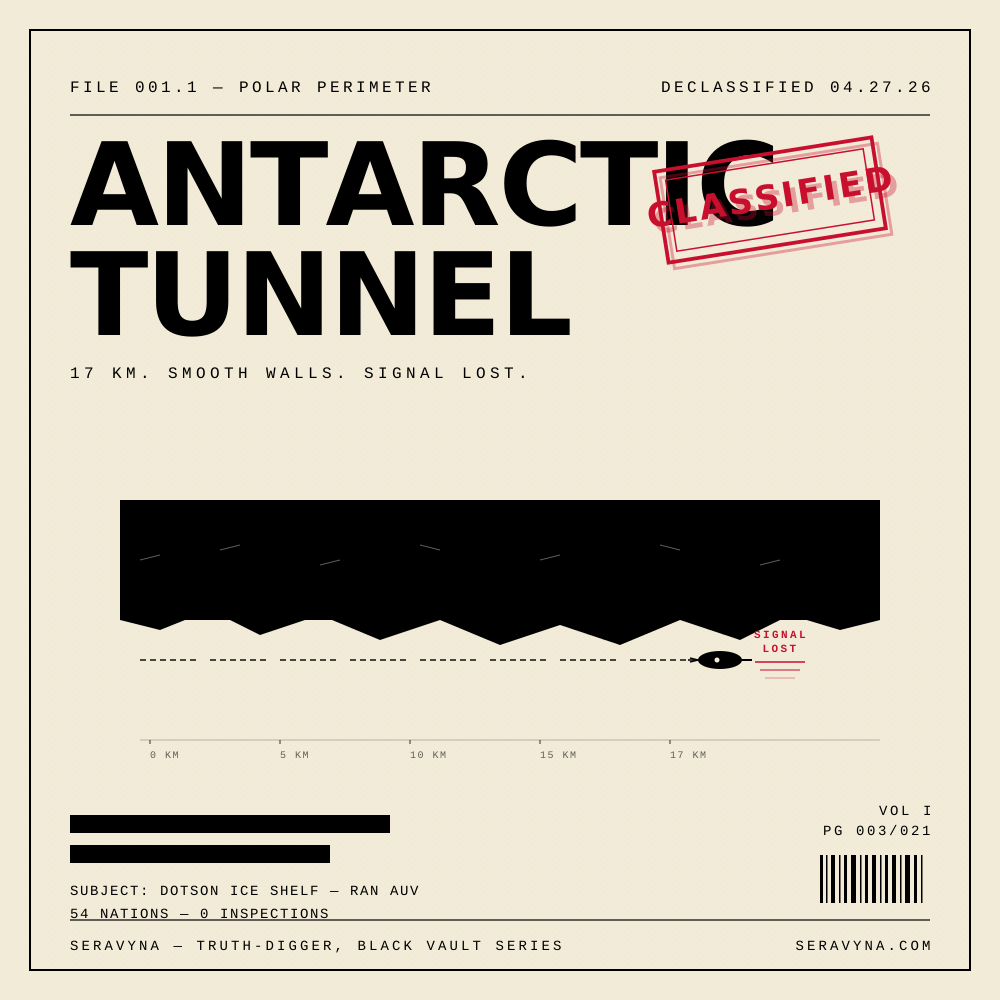
In early 2024, a $3.6 million autonomous research submarine vanished under the Dotson Ice Shelf in West Antarctica, and no fragment of it has ever been recovered.
The vehicle was called Ran. It had successfully completed a 27-day mission under the same ice shelf in 2022, returning the first high-resolution maps of a 17-kilometer corridor of unexplained ice formations beneath the floating glacier. On its second mission, sent back to remap the same area, it completed one dive and went silent. No signal. No collision alert. No body.
Just a corridor of smooth, sculpted ice it had been mapping, the kind of corridor mainstream researchers themselves admit "current models cannot explain," and then silence.
I want to walk you through what we actually know about that mission, what the published research says about what Ran found before it disappeared, and why the Antarctic Treaty's inspection clause has gone almost completely unused for sixty-five years. The full investigation is in Beyond The Ice Wall, Book One of the 20-volume Black Vault Series, but the core of what made readers ask "who built it, who used it" is what I want to lay out for you here.
What the Ran Submersible Actually Found Under the Ice
This part is documented. Peer reviewed. Published in Science Advances. I want to start there because the foundation has to be solid before anything else makes sense.
Ran was an autonomous underwater vehicle operated by the University of Gothenburg, designed to map the underside of Antarctic ice shelves using advanced sonar. In a 2022 expedition, it spent 27 days under the Dotson Ice Shelf in West Antarctica, traveling more than 1,000 kilometers back and forth, reaching 17 kilometers into the cavity beneath the floating ice. That single dive returned the first high-resolution maps of the underside of an Antarctic glacier.
What the maps showed isn't what the researchers expected. They found:
Terraced steps stacked like a staircase along the eastern flank of the shelf
Teardrop-shaped pits measuring up to 984 feet long and 164 feet deep
Channels and grooves carved in patterns the lead researcher described as seeing "the back of the moon for the first time"
Smoothed surfaces with regular, almost rhythmic structure the team had no model to explain
Full-thickness fractures slicing through the ice shelf, smoothed at their bases by something the data couldn't fully account for
One of the Earth.com reports on the mission summarized the team's reaction directly:
"Current models cannot explain the complex patterns we see."
Then in early 2024, Ran was sent back for a follow-up mission to remap the same area and document changes. It completed only one dive before it disappeared.
The disappearance left no trace:
No wreckage was ever recovered
No signal was returned through any channel
No collision alert registered before the loss of contact
No acoustic pings came back from teams attempting to reach it (the only kind of communication possible under hundreds of meters of solid ice)
The mainstream framing is that Ran probably hit something or got stuck. The official explanation is "the difficulties of operating robotic technology in one of Earth's most inaccessible environments." That's a fair explanation. It's also the kind of explanation that doesn't tell you anything specific.
What I want to ask you is this. If a $3.6 million autonomous research submarine designed for exactly this environment, on its second pass through a corridor it had already mapped, simply vanished without a single fragment recovered, what kind of pattern is that consistent with?
The Antarctic Treaty Lets Anyone Inspect Anything. Almost Nobody Has.
This is where the story gets harder to brush off, and I want to be careful here because the facts are public and the implications are genuinely strange.
Article VII of the Antarctic Treaty, signed December 1959, grants every Consultative Party the right to inspect every other party's installations, equipment, ships, and aircraft anywhere in Antarctica. The exact language from the treaty text: "all areas of Antarctica, including all stations, installations and equipment within those areas, and all ships and aircraft at points of discharging or embarking cargoes or personnel in Antarctica, shall be open at all times to inspection."
What this means in practice:
No carve-outs. No restricted zones the treaty allows
No advance notice required. Inspections can happen at any time
Aerial observation permitted. At any time, over any area
Universal scope. Stations, installations, equipment, ships, aircraft, all included
54 parties total, of which 29 are Consultative Parties with full inspection rights
So in principle, 29 nations have had the legal right to walk into any other nation's Antarctic facility, at any time, without prior notice, for sixty-five years.
I went looking for the inspection records. Here's what I found.
The U.S. State Department's own historical archive from 1962-63 contains an internal memo discussing whether to exercise the treaty's inspection rights. The memo records the official hesitation directly. Inspections might risk "arousing suspicion and adversely affecting the climate of friendly cooperation." Exercising inspection rights "when there is no evidence of wrongdoing" might suggest "our predilection for inspection systems is based on inspection-for-its-own-sake."
Translation: the United States considered inspecting Antarctica, then officially decided not to because doing so might look like we expected to find something.
That memo is from 1962. The pattern of restraint it describes has continued. In the sixty-five years since the treaty entered force, formal inspections have been rare and largely confined to coastal research stations, conducted with advance notice in most cases, and almost never directed at restricted interior zones or under-ice installations.
Fifty-four nations had the right to look. Most of them never used it.
I'm not telling you why. I'm telling you the records show they didn't.
What the Framework I've Built Across the Series Actually Proposes
I want to be transparent about what's mine and what's not.
What's documented in mainstream sources:
The Ran submersible's findings under the Dotson Ice Shelf
The 17-kilometer corridor with patterns mainstream researchers cannot explain
The disappearance in early 2024 with no recovery
The Antarctic Treaty's inspection language in Article VII
The State Department's documented hesitation to exercise inspection rights
What's not in the mainstream record is the framework that connects these into a coherent story. That part is what I lay out in Beyond The Ice Wall.
The framework proposes that Antarctica is not what the official record describes. It is not a uniformly studied scientific preserve where research operates under transparent international cooperation. It is a perimeter, defended by a treaty structured to discourage exactly the kind of inspection that would expose what's underneath the ice. The "Isolated Colony Zones" referenced on certain pre-treaty Naval cartography (which I document in the book with the original archive citations) describe sectors that have never been formally inspected, are not present on the post-treaty public maps, and align geographically with the same regions where modern research vehicles have repeatedly experienced anomalous events.
What's underneath the ice in those sectors is the question the book is built around.
The corridor Ran was mapping when it disappeared sits at the western edge of one of those sectors. The smooth, sculpted patterns the researchers couldn't explain are consistent with the kind of feature you'd expect to find if the underside of the ice shelf wasn't entirely natural. The disappearance is consistent with the kind of event you'd expect if something didn't want to be mapped.
I'm not asking you to believe any of this on my word. I'm asking you to look at three things together: the published research, the inspection records, and the geographic pattern. And then ask yourself the same question my readers have been asking me: who built it, who used it, and why has nobody with the legal right to look ever bothered to walk down there and find out?
Frequently Asked Questions
Did the Ran submersible really disappear under the ice?
Yes. It was an autonomous underwater vehicle operated by the University of Gothenburg, and after returning successfully from a 2022 expedition under the Dotson Ice Shelf, it disappeared during a follow-up mission in early 2024. No wreckage or signal was ever recovered. The disappearance is documented in mainstream scientific outlets including the British Antarctic Survey and the University of Gothenburg's own press release.
How long was the corridor it was mapping?
The 2022 expedition reached 17 kilometers into the cavity beneath the Dotson Ice Shelf, returning over 1,000 kilometers of total survey data across 27 days. That figure is from the published study in Science Advances.
What did the maps show?
Terraced ice formations, teardrop-shaped pits up to 984 feet long, smoothed channels, and full-thickness fractures. The lead researcher described the patterns as something current models "cannot explain." The findings were published in Science Advances in late 2024.
Is the 17 km figure the same as the 18 km figure?
The exact number reported in the Science Advances paper is 17 kilometers. Earlier press coverage and some social media discussions have used 18 kilometers as a rounded figure. The difference is one kilometer.
Does the Antarctic Treaty really grant universal inspection rights?
Yes. Article VII grants every Consultative Party "complete freedom of access at any time to any or all areas of Antarctica," including stations, installations, equipment, ships, and aircraft. Aerial observation is permitted at any time over any area. There are no exceptions written into the treaty.
Why hasn't every nation used those rights?
The U.S. State Department's own historical archive records the official hesitation. The internal logic is that exercising inspection rights without evidence of wrongdoing might "arouse suspicion" or damage diplomatic cooperation. That logic, established in 1962, has shaped inspection practice for sixty-five years.
Is this real or fiction?
It's investigative speculative nonfiction. The evidence I cite (the Ran expedition, the Antarctic Treaty text, the State Department archive, the missing submersible) is real and verifiable. The framework that connects these elements into a coherent story is my contribution. Readers are encouraged to verify the sources themselves.
How does this connect to the rest of the Black Vault Series?
The Ran submersible incident is one of dozens of anomalies I document in Beyond The Ice Wall, Book One of the 20-volume series. Sealed Sky (Book 2) maps the dome above the perimeter. Frequency Cage (Book 3) maps the signal architecture. Soul Harvest (Book 4) and There Is No God (Book 5) extend the investigation. Books 7 through 20 are in development.
Where do I start if I'm new to the series?
Begin with Beyond The Ice Wall. The series is designed to be read in order. The Antarctic perimeter is where the whole investigation begins.
What Comes Next
Here's where I land on this.
A research submarine vanished inside a corridor mainstream science admits it doesn't understand. Sixty-five years of inspection rights have gone almost entirely unused at the only continent on Earth without a permanent population. The maps that did exist before the treaty was signed are no longer in the public record, but the catalog references to them survive.
You don't need a framework to find this strange. You only need to read what's already published.
But if you want the framework, the original archive citations, the geographic alignment of the unexplained zones, and the deep-vault addendum that I built this whole series around, that's what Beyond The Ice Wall delivers.
The Ran submersible is somewhere under the ice right now. Whatever it found in the last hour of its dive, somebody knows. Whoever knows hasn't said.
I think it's time we asked them to.
Beyond The Ice Wall, Book One of the 20-volume Black Vault Series, is available now on Amazon. The first six books are out. Fourteen more are in development. The submersible records and the original cartography references are in chapters one through nine. The treaty analysis is in chapter twelve. The deep vault addendum is what no civilian was supposed to see. You can browse the full Black Vault Series on Amazon here.
Seravyna ♛
Responses
What are your thoughts on this post?