There is a piece of laboratory-grade scientific instrumentation in your kitchen drawer right now, and tonight, between two and four in the morning, you can use it to register evidence of a phenomenon no official framework predicts and no mainstream explanation fully accounts for.
You've walked past it for years. You used it during the storm last winter when the power went out. It cost less than a steak dinner.
You don't need a laboratory.
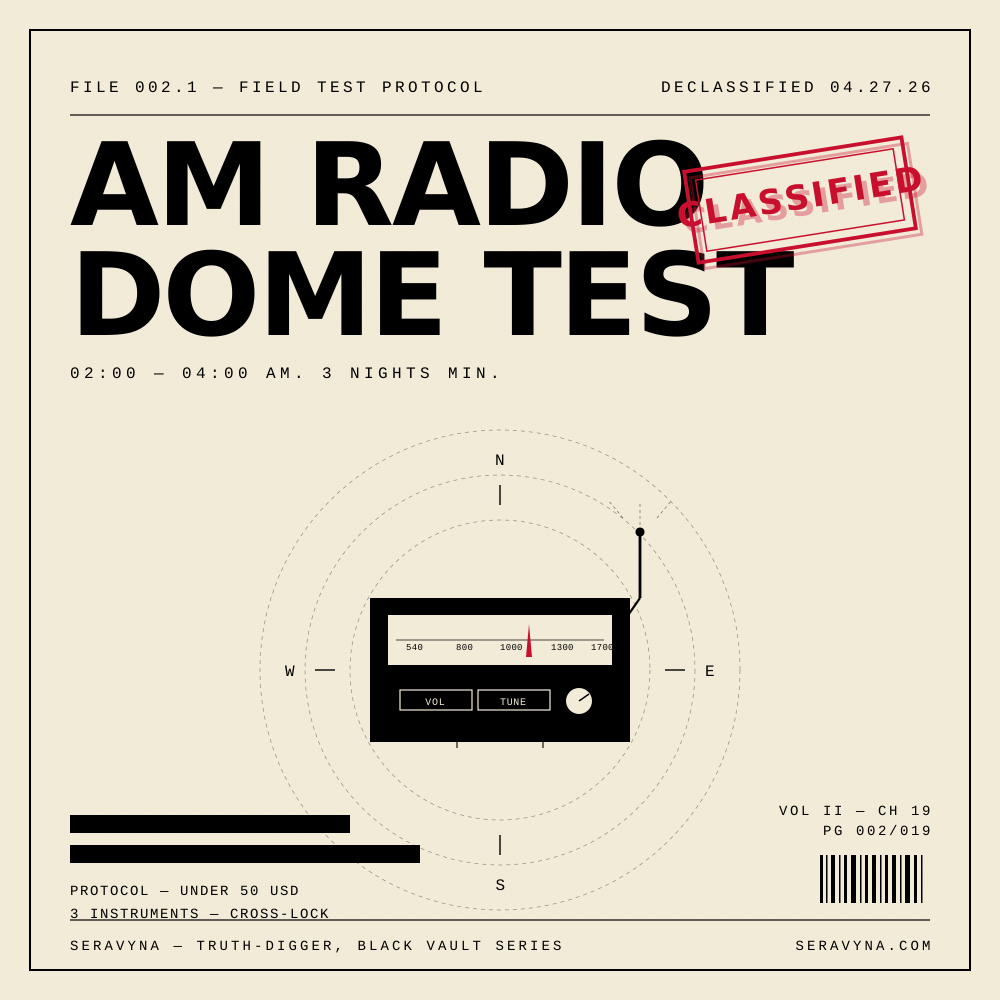
You need a notebook, a compass, and a portable AM radio.
In this post I'm going to walk you through the consumer-grade instrumentation protocol from Chapter 19 of Sealed Sky, the second book in the 20-volume Black Vault Series. The protocol is reproducible, the equipment costs under fifty dollars total, and the readings are either there or they're not. You don't have to take the framework on faith. You can verify it yourself, and I want to show you how.
Why AM Radio at Night?
Let's start with the science nobody disputes, because I think it's important you see that the foundation here is solid before we get to the interesting part.
During the day, the lowest layer of Earth's ionosphere (called the D-layer) sits between 30 and 60 miles above the surface and absorbs long-wavelength AM radio signals. That's why daytime AM reception is mostly limited to local stations. The signal travels along the curve of the Earth and that's about it.
At night, the D-layer disappears. NOAA's own documentation states that "at night, [the ionosphere's layers] decrease in density, with the D-Layer essentially disappearing." And here's where it gets interesting, in the FCC's own words:
"The propagation of AM radio waves changes drastically from daytime to nighttime. Because of the way in which the relatively long wavelengths of AM radio signals interact with the ionized layers of the ionosphere miles above the earth's surface, the propagation of AM radio waves changes drastically from daytime to nighttime."
That's the federal government acknowledging that the sky behaves differently after dark in a way that physically changes what your radio can receive. It's why most AM stations are legally required to reduce their broadcast power after sunset. If they didn't, every station in the country would be interfering with every other station every night.
I want you to notice something. None of what I just told you is fringe. It's published by the federal government and confirmed by NOAA. It's why your AM radio sounds different at 3 AM than it does at 3 PM.
Here's where the investigation begins.
The official explanation calls the dropouts in nighttime AM static "atmospheric interference." Mainstream science attributes them to ionospheric undulation, which Wikipedia describes as the ionosphere's reflective layer being unstable and producing fading "with nighttime AM broadcast signals."
That's one explanation. And it's a real one for some of the dropouts.
The question I want to ask you, though, the question that started me down this path, is whether all the dropouts are random.
Because if the dome theory framework holds up, some of those dropouts shouldn't be random at all.
Your Experiment Kit: What to Buy on Amazon
I've done the research for you. These are the exact products that work for this protocol, all available on Amazon, all under fifty dollars total. I'd recommend opening these in a new tab and grabbing them now so you can run the protocol this week.
The AM radio: Panasonic Portable AM/FM Radio (RF-2400D). Around thirty dollars. Large analog dial with a fluorescent pointer that's easy to read in the dark, runs on either four AA batteries or AC power, and the build quality is high enough that you won't accidentally damage the antenna while rotating it. This is the one I recommend.
The compass: TurnOnSport Orienteering Compass. Around twelve dollars. A liquid-filled needle that swings fast and points clean. Has the 360-degree rotating bezel and the baseplate you'll need for taking precise compass bearings.
The diffraction film: Bartovation Diffraction Grating Sheet, 13,500 Lines/Inch. Around fifteen dollars. This is the same film used in physics classrooms. Double-axis, optimized to eliminate visual noise so you'll see clean spectral banding when it's there. Comes in a roll you can cut down.
The barometer (optional, for phase two): AcuRite Digital Vertical Weather Forecaster (01121M). Around twenty-five dollars. Tracks twelve-hour pressure trends visually, which is what you want for spotting the kind of pressure spikes the protocol asks you to log.
A notebook and pencil. Whatever's in your kitchen drawer. I'd avoid using your phone for this. There's something about handwritten field notes that makes you take the data more seriously.
Total cost for the full kit: around eighty-two dollars. Total for the minimum kit (radio, compass, diffraction film, notebook): about fifty-seven dollars. You can also do phase one alone for about forty-three dollars if you want to start tonight and add the barometer later.
If you want to wait and try a thrift-store radio first, that works too. The protocol is designed to be cheap.
The Protocol: Phase One
The first phase uses only the AM radio, the compass, and the notebook. I want you to run this for a minimum of three consecutive nights before drawing any conclusions. One night of data is anecdote. Three nights of data is a pattern.
Here's how it works:
Between 2:00 and 4:00 AM local time, take the radio and compass to a window or balcony with a clear view of the sky. Note the date, the time, your location, and the compass bearing you're facing.
Tune the AM radio to a dead frequency between stations. The cleanest dead spaces are usually between 1300 and 1500 kHz. The static should be steady, hissing, with no recognizable signal.
Listen for thirty minutes. Record every dropout in your notebook. A dropout is a brief moment when the static cuts out, drops in volume, or shifts in tone. Most last between half a second and three seconds. Note the exact time of each one.
Rotate the radio. Holding the compass in your other hand, slowly rotate the radio through 360 degrees. AM radios have directional antennas, which means the signal strength changes depending on which way the radio faces. Note the compass bearings where dropouts occur most frequently.
Repeat across three to seven consecutive nights. Same time. Same location. Same starting compass bearing.
You'll be surprised how many dropouts you hear once you're listening for them. I was.
What you're looking for is whether the dropouts cluster at specific compass bearings consistently across multiple nights, or whether they distribute randomly.
The mainstream prediction is randomness. Atmospheric interference is, by definition, random. Ionospheric undulation should produce dropouts at all bearings roughly equally over enough observation time.
The investigation's prediction is clustering. If the dome theory framework is correct, the maintenance windows in the lattice should produce repeatable dropouts at fixed compass bearings, repeating on schedules.
You decide what your data shows. That's not me being humble. That's me telling you the only honest position to take with field data.
The Protocol: Phase Two
If your phase one data shows clustering at fixed bearings, phase two adds the barometer for cross-lock confirmation, and this is where it starts getting genuinely interesting.
A standard digital barometer placed near an open window during the same 2:00 to 4:00 AM observation window will register pressure fluctuations. Most fluctuations are tiny, on the order of 0.1 to 0.3 hectopascals, and they correlate with weather systems passing through. Normal stuff.
What I want you to look for is sudden shifts of 0.7 to 1.7 hectopascals that resolve within minutes. Not a gradual trend. A spike, then a return to baseline, all within a five to ten minute window.
Run the barometer alongside the radio. Note the time of every pressure spike. Then compare those times against your radio dropouts.
Two predictions, two outcomes:
Mainstream prediction: No correlation. Pressure shifts and radio static dropouts have different physical causes (atmospheric weight versus ionospheric reflection) and shouldn't synchronize. There's no reason in conventional physics for them to.
Investigation's prediction: Correlation. If the dropouts and the pressure spikes both originate from the same underlying lattice maintenance event, they should occur within the same minute on multiple observations.
If you find correlation, you've moved beyond anecdote into measurement. That's a real moment, and I want you to document it carefully.
The Protocol: Phase Three
Phase three is the visual confirmation, and it's the one most people skip because they think it sounds too simple. Don't skip it.
You'll need diffraction film, which is a transparent plastic sheet coated with a microscopic grating that splits visible light into its component spectrum. The Bartovation sheet I linked above is the right one for this protocol.
Place a flashlight on a tripod or stack of books and aim it straight up at the sky. Hold the diffraction film in front of the flashlight. The light passing through the film will split into a rainbow pattern.
Here's what to watch for:
What the mainstream framework predicts: A clean, unbroken rainbow gradient with no horizontal banding.
What I want you to look for: Thin horizontal lines or banding patterns within the diffracted light. If you see them, photograph them with your phone. Use night mode and long exposure if your phone supports it.
The crucial test: Move yourself two meters to the left or right while keeping the flashlight and film stationary. If the horizontal banding shifts position relative to your eyes, it's an optical artifact and you can ignore it. If the banding stays at the exact same compass bearing regardless of your viewing position, it's not in your eyes. It's in the medium the light is passing through.
Cross-reference with the compass bearings where your radio dropouts cluster.
If the visual banding appears at the same bearings as your radio dropouts, on the same nights, you've triangulated three independent measurement modalities pointing at the same coordinate space.
That's not anecdote anymore. That's observed phenomenon. And once you see it, you can't unsee it.
What the Mainstream Framework Says About All This
I want to be transparent with you about something, because it matters for how you interpret your data.
Mainstream atmospheric science has explanations for every individual phenomenon I've described above:
AM radio dropouts at night are explained by ionospheric undulation and skywave fading. The reflective layer of the ionosphere isn't stable, and varying reflection efficiency causes signal strength to fluctuate.
Pressure fluctuations are explained by passing weather fronts, internal atmospheric waves, and tidal effects.
Visual banding in diffracted light is explained by atmospheric particles, humidity gradients, and microscopic dust.
Each of these explanations is real. Each one accounts for some portion of the observations.
The question I'm asking, the one that Sealed Sky is built around, is not whether mainstream explanations exist. They do. The question is whether mainstream explanations fully account for the clustering pattern across all three instrument types when you run them simultaneously at fixed compass bearings across multiple nights.
If clustering is real and reproducible, the mainstream explanation has a problem. Random atmospheric phenomena shouldn't produce repeatable, bearing-locked, time-correlated readings across three independent instrument modalities. That's not how randomness works.
I'm not asking you to believe anything. I'm asking you to run the protocol, record the data, and see what your own instruments show. That's it.
What to Do With Your Data
There are three possible outcomes when you finish this protocol, and I want to walk you through each one honestly:
You find random distribution across all three phases. Within the limits of your instrumentation, you haven't found evidence for the framework. That's a legitimate result. Investigation requires the willingness to find nothing, and I want to be the kind of researcher who tells you that up front.
You find clustering at fixed bearings in phase one but no correlation in phases two or three. You might be observing real but conventional atmospheric phenomena. Still useful information.
You find clustering, correlation, and bearing-locked visual banding across multiple nights. You've personally observed something the official framework doesn't predict and the mainstream model doesn't fully explain.
If you land in that third outcome, here's what I'd recommend you do next:
Document everything. Date, time, location, compass bearings, exact dropout durations, exact pressure readings. Photograph the visual banding when present. The more specific your records, the more useful they become later.
Compare across observers. If you have friends or readers in other geographic locations running the same protocol on the same nights, the cross-location comparison is where the data becomes powerful. The framework predicts that lattice maintenance windows are global events, meaning observers thousands of miles apart should see clustering on the same nights at compass bearings that point toward the same underlying nodes. That's a testable prediction.
Frequently Asked Questions
Is AM radio dropout testing a real scientific protocol?
The underlying physics of AM radio nighttime propagation is established and well-documented by the FCC, NOAA, and atmospheric science publications. The protocol I'm describing uses standard equipment in a standard frequency range. The interpretation of clustering patterns as evidence for the dome theory framework is my investigative thesis, not mainstream science. Both parts of that distinction matter.
Why between 2 and 4 AM?
This is the deepest part of the night when ionospheric activity is most stable and the D-layer of the ionosphere has fully disappeared. It's also when human radio interference is at its lowest, since most consumer electronics are off. The 2-4 AM window minimizes noise from sources you don't want to measure.
What if I can't stay up that late?
Run the protocol on weekends. Or use a phone recording app to capture the AM static between 2 and 4 AM and analyze the recording the next morning. The dropouts and the timing data are preserved either way.
Will this work in a city versus a rural area?
Both. Cities have more electromagnetic noise, which makes phase one harder but not impossible. Rural areas give you cleaner data. If you're in a major urban area, choose the highest floor you have access to and pick frequencies at the upper end of the AM band (1500-1700 kHz) where commercial broadcast density is lowest.
Does the equipment brand matter?
The radios and compasses I linked above are the ones I tested with. Cheaper analog AM radios from thrift stores often work just as well, sometimes better, because they have less internal signal processing that might filter out the dropouts you're trying to detect. Either way, an analog dial is the key feature you want.
What if I find clustering but can't reproduce it?
Reproducibility takes patience. The framework predicts that maintenance windows occur on schedules, not continuously. Some nights will show clustering. Some nights won't. The pattern only emerges across multiple weeks of observation. If you're giving up after three nights, you're operating on the wrong timescale.
Is this safe?
Yes. AM radio reception, barometric pressure observation, and diffracted flashlight viewing are all completely safe. The protocol uses no hazardous materials and exposes you to no health risks beyond staying up late.
How does this connect to the rest of the Black Vault Series?
This protocol is from Chapter 19 of Sealed Sky, Book Two of the 20-volume series. Beyond The Ice Wall (Book 1) maps the perimeter. Sealed Sky maps the ceiling. Frequency Cage (Book 3) extends the instrumentation framework to bioelectric and ELF measurements. Soul Harvest (Book 4) and There Is No God (Book 5) continue the investigation. Books 7 through 20 are in development. You can browse the full Black Vault Series on Amazon here.
What Comes Next
Here's where I land on this.
The system has counted on your inattention for a long time. Most people walk past the AM radio in their kitchen drawer and never think of it as an instrument. Most people accept "atmospheric interference" as an explanation without ever asking what the interference is actually interfering with.
I don't think you should be most people anymore.
Tonight, between two and four in the morning, you can either stay asleep or you can sit by an open window with a five-dollar radio and a notebook and personally generate evidence one way or the other. I know which one I think is more interesting.
If you find nothing, you've lost two hours of sleep and gained certainty.
If you find something, you've just become an investigator.
The full protocol, including the cross-lock methodology, the bearing triangulation method, the global observer network coordinates, and the deep-vault addendum that no civilian was supposed to see, is in Sealed Sky. This blog post is the field-test introduction. The book is the investigation.
Sealed Sky, Book Two of the 20-volume Black Vault Series, is available now on Amazon. The first six books are out. Fourteen more are in development. Begin with Beyond The Ice Wall if you're new to the series. Read the full Sealed Sky pillar investigation here for the evidence, the locations, and the framework.
Responses
What are your thoughts on this post?