


I used to think near-death experiences were one of the strangest mysteries in human consciousness. People dying on operating tables, in car wrecks, on hospice beds, in cardiac arrest, returning to describe the same handful of structural elements with such consistency that the pattern itself becomes the evidence. The tunnel. The brilliant light. The deceased relative waiting to greet them. The life review. The wise guide figure who escorts them. The threshold they were called to cross.
I assumed, like most people who have heard these stories, that the consistency proved something profound about the structure of the afterlife. And then I sat down with the four hundred and twelve clinical interviews assembled in There Is No God, alongside Bruce Greyson's fifty years of NDE research at the University of Virginia, the 2023 Proceedings of the National Academy of Sciences paper documenting heightened brain activity in dying patients, and the CIA's declassified 1983 Gateway Process report on consciousness research.
What I found is that the consistency does prove something. It just does not prove what most people assume.
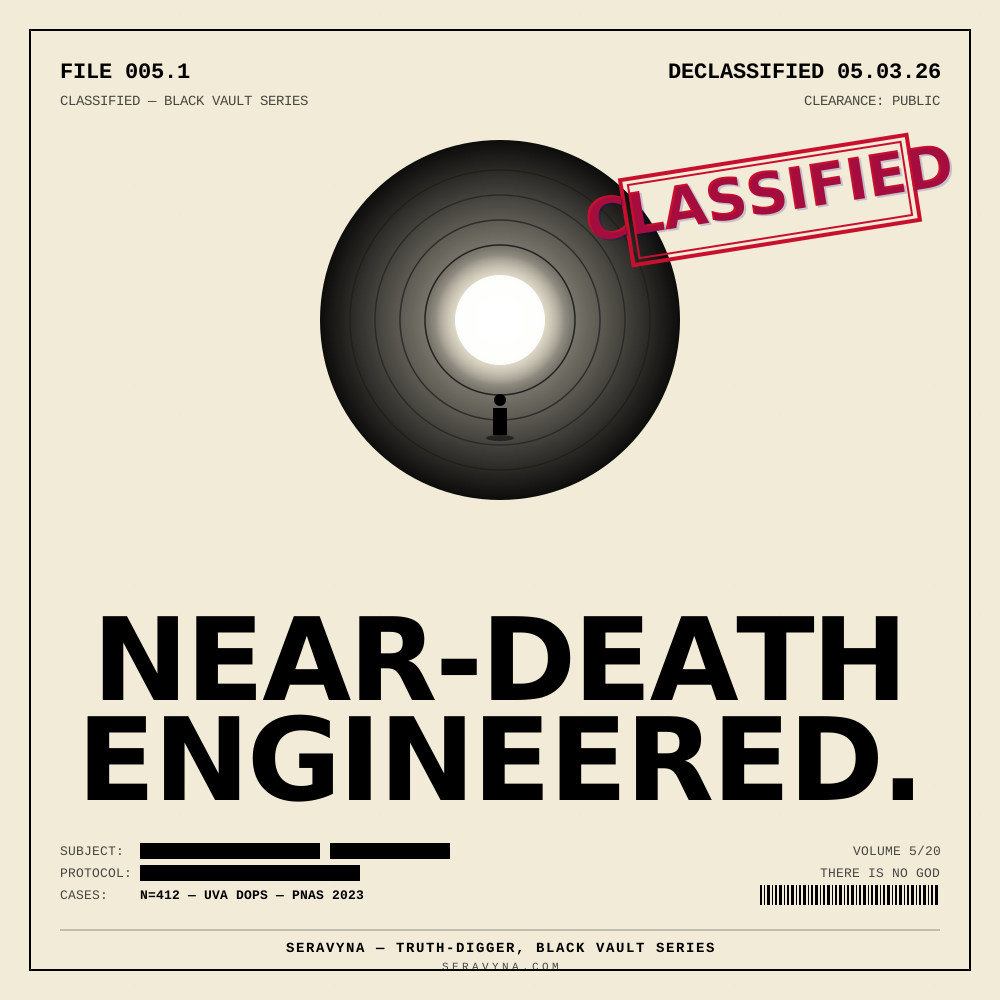
In this post I want to walk you through what the documented research actually shows about the structure of NDEs, why the consistency of the elements points away from a personal spiritual journey and toward something more disturbing, the twelve simulation types Noel Donnelly's clinical taxonomy identified across hundreds of NDE survivors, and what There Is No God, Book Five of the 20-volume Black Vault Series, documents about why an experience that feels like the most personal moment of your life produces the same elements in millions of independent strangers.
What The Mainstream Research Actually Shows
Let me put the documented baseline on the table first, because the credibility of everything that follows depends on the science being airtight.
The University of Virginia's Division of Perceptual Studies, founded in 1967, has been the world's primary academic NDE research center for over half a century. Bruce Greyson, the unit's former director and the world's foremost NDE researcher, has documented over 1,000 cases and developed the internationally accepted Greyson NDE Scale used to classify and measure NDE experiences. The University of Virginia continues to publish peer-reviewed research on NDEs through 2025.
The 2023 PNAS paper by Xu et al. at the University of Michigan documented something the medical literature had never directly observed before. Out of four comatose patients who died in the University of Michigan neuro-intensive care unit, two showed paradoxically heightened brain activity in their final minutes. Specifically, they showed surges of gamma wave oscillations in a region called the temporo-parieto-occipital junction, and increased functional connectivity between that region and the prefrontal cortex.
What the documented research has established about NDE structure:
Approximately 10 to 20 percent of cardiac arrest survivors report NDE-like experiences, with the higher figure in studies that interviewed patients carefully and quickly after resuscitation
The same structural elements recur across cultures, languages, and religious backgrounds: the out-of-body experience, the tunnel, the light, the life review, the encounter with deceased relatives, the wise guide figure, the threshold or border, the conscious decision to return
Children's NDE accounts contain the same structural elements as adult accounts, despite the children having no prior cultural exposure to NDE narratives
NDE-like experiences also occur in non-death contexts including deep meditation, certain pharmacological states, severe stress, and high-G-force conditions in fighter pilots, suggesting the elements emerge from specific brain states rather than from contact with a non-physical realm
The brain activity surge occurs in the temporo-parieto-occipital junction, the same region peer-reviewed research has correlated with out-of-body experiences, dreaming, and altered states of consciousness
That last point is the one most coverage skips. The dying brain is not silent. It is paradoxically active in exactly the brain region that produces the structural elements of the NDE experience.
The mainstream interpretation is that the dying brain produces NDEs. That interpretation is supported by the documented neuroscience.
The interpretation in There Is No God is different. It is also supported by the same documented neuroscience.
The Question Mainstream Coverage Skips
Here is the part that becomes harder to dismiss the longer you sit with it.
The 2022 Frontiers in Psychology paper neuro-functional modeling of NDEs by Romand and Ehret reviewed the published research on NDEs from drug-induced states, epilepsy, brain stimulation, ischemic stress, and fighter-pilot G-LOC tests. The paper concluded that across all these distinct triggers, the same set of phenomenological elements emerge with high consistency: out-of-body experience, tunnel vision, brilliant light, encounters with presences, life review, sense of crossing a border.
"We found a large overlap of NDE themes or topics from original NDE reports with those from neuro-functional NDE models. Collectively, the models offer scientifically appropriate causal explanations for the occurrence of NDEs."
I want you to read that twice.
The same elements emerge whether the trigger is dying, fainting, deep meditation, severe G-force, hypoxia, drugs, or epileptic seizures. The brain region producing them (the temporo-parieto-occipital junction) is the same. The structural template is the same.
Mainstream science interprets this as evidence that NDEs are products of consistent brain states. That interpretation is correct as far as it goes. But it leaves a question the mainstream research has not answered, and that There Is No God takes as its starting point.
If the structural template is consistent across millions of independent humans across thousands of years across all known cultures, regardless of the specific trigger, then whatever is producing these experiences is producing them according to a specification. A specification that does not vary with culture, language, religion, era, or trigger mechanism. A specification engineered into the architecture of human consciousness itself, deployed reliably whenever the right brain state is activated.
The mainstream interpretation calls this specification a byproduct of evolution.
The interpretation in There Is No God calls it a feature of the system, deployed for a purpose.
The neuroscience is identical. The interpretation diverges at the question of whose specification it is.
The 12 Simulation Types
The most clinically rigorous attempt to map NDE structure systematically comes from Noel Donnelly's psychiatric practice, documented in There Is No God. Donnelly built a clinical taxonomy of twelve simulation types based on four hundred and twelve interviews with NDE survivors over seven years of practice in Dublin. The taxonomy organizes NDE elements not by phenomenology (what the elements look like) but by mechanism of action (what the elements do to the experiencing consciousness).
The six most commonly encountered types in the clinical population:
The Welcome. The most common type. The consciousness arrives in an environment of warmth, light, and overwhelming arrival, the feeling of having reached somewhere it was always meant to be. There is no specific presence, just the environment itself producing the emotional response. Mechanism: environmental emotional activation that bypasses critical evaluation in a maximally vulnerable consciousness.
The Familiar Face. A deceased relative or close friend appears and communicates with the experiencing consciousness. The presence is constructed from the survivor's own biographical emotional record, using the specific person whose appearance produces the highest attachment activation. Mechanism: personalized attachment activation, highest emotional power in the threshold repertoire.
The Light. A brilliant light source appears, experienced not as an external object but as a presence: warm, intelligent, unconditionally loving. The pull toward the light is the most powerful directional cue in the NDE experience. Mechanism: directional pull amplified by electromagnetic resonance, routes the consciousness toward subsequent processing stages.
The Life Review. The survivor's actual biographical memories are presented in vivid sequence, often experienced from multiple perspectives including the perspective of the people they affected. The memories selected are not random. Mechanism: targeted biographical memory deployment for compliance generation, creates motivation to return to embodied life through unfinished relational business.
The Guide. An unfamiliar presence appears as escort or navigator, offering to lead the consciousness through the threshold environment. The Guide presents as the expert in this environment, the one who knows the way. Mechanism: authority compliance activation, exploits the human tendency to follow recognized authority in unfamiliar territory.
The Border. A wall, river, fence, or similar structural boundary appears, and the consciousness understands that crossing it is irreversible. The Border is presented as the survivor's choice to make. Mechanism: agency illusion that frames the routing system's predetermined output as the consciousness's own free decision.
The taxonomy continues for six additional types. The clinical insight that distinguishes Donnelly's work is the consistent observation that what the survivors describe as their most personal, most spiritual, most meaningful experience matches the structural specification of survivors who have nothing else in common: different cultures, different religions, different languages, different ages, different causes of clinical death.
If your most personal experience is structurally identical to a million strangers' most personal experiences, the experience is not personal. The experience is engineered.
What the Framework I've Built Across the Series Actually Proposes
I want to be transparent about what's documented and what's mine.
What's documented in mainstream peer-reviewed sources:
The University of Virginia's 50+ years of NDE research, the Greyson NDE Scale, and Greyson's documented 1,000+ case database
The 2023 PNAS paper by Xu et al. documenting paradoxically heightened brain activity in dying patients in the temporo-parieto-occipital junction
The 2022 Frontiers in Psychology paper documenting the consistency of NDE elements across multiple distinct triggers
The CIA's 1983 Gateway Process report, declassified in 2003, examining consciousness research and altered states
The PNAS 2023 commentary by Christof Koch of the Allen Institute, treating the dying brain's gamma surges as a documented mainstream finding
The University of Virginia's 2025 research on counseling support for NDE survivors, demonstrating ongoing institutional engagement with the phenomenon
What's not in the mainstream record is the framework that interprets the documented consistency as evidence of an engineered specification rather than an evolutionary byproduct. That part is what I lay out in There Is No God.
The framework proposes that the NDE phenomenon is a documented routing architecture deployed at the moment of biological death, designed to process consciousness through specific stages, and that the consistency of the experience across millions of independent humans is the operational signature of that architecture rather than coincidence or shared neurology. The book documents Noel Donnelly's full twelve-type taxonomy, the clinical implications for survivors, and the deep-vault material on what the routing architecture's output is and where it routes to.
You don't have to accept the framework on my word. The University of Virginia research is searchable. The PNAS papers are open access. The CIA Gateway Process report is in the agency's online reading room. The components are all in the public record. What I have done in There Is No God is put them in the same room and ask the question the mainstream research did not.
Frequently Asked Questions
Are near-death experiences real?
Yes. The phenomenon of NDE-like experiences in cardiac arrest survivors and other near-death states is documented in over 50 years of peer-reviewed research, primarily from the University of Virginia's Division of Perceptual Studies. Bruce Greyson's career database includes over 1,000 cases. The Greyson NDE Scale is internationally accepted in clinical and research contexts.
What does the 2023 PNAS study show?
The Xu et al. paper at the University of Michigan documented that two of four comatose patients in the neuro-intensive care unit showed paradoxically heightened brain activity in their final minutes after withdrawal of ventilatory support. The activity was a surge of gamma oscillations and functional connectivity in the temporo-parieto-occipital junction, the same brain region peer-reviewed research has correlated with out-of-body experiences and altered states of consciousness.
Why are NDE experiences so similar across cultures?
This is the central question of the phenomenon. Mainstream interpretation attributes the consistency to the consistent neural mechanisms that produce NDE-like states across distinct triggers. The interpretation in There Is No God argues that the consistency points to an engineered specification deployed at the moment of biological death, with the neuroscience documenting the mechanism rather than the origin.
What was the CIA Gateway Process report?
The Gateway Process was a 1983 internal U.S. Army intelligence report by Lieutenant Colonel Wayne M. McDonnell analyzing techniques developed at the Monroe Institute for achieving altered states of consciousness through binaural beats and hemispheric synchronization. The report examined the implications for consciousness research, including questions about the nature of consciousness and its relationship to physical death. It was declassified in 2003 and is publicly available in the CIA's online reading room.
Who is Noel Donnelly?
Donnelly is the psychiatrist whose clinical practice in Dublin, documented in There Is No God, produced the 12-simulation taxonomy of NDE types based on 412 clinical interviews with NDE survivors over seven years of practice. The taxonomy organizes NDE elements by mechanism of action rather than phenomenology, providing survivors with a clinical framework for understanding why specific elements affected them as they did.
Does this mean there's no afterlife?
The framework in There Is No God does not argue that there is no afterlife. It argues that what the documented NDE phenomenon shows is a specific architecture deployed at the threshold of biological death, and that the architecture's output should not be assumed to be the totality of what happens to consciousness. The book's deep-vault material distinguishes between the architecture and what may exist beyond its operational reach.
Is this real or fiction?
It's investigative speculative nonfiction. The University of Virginia research, the PNAS papers, the Frontiers in Psychology meta-analysis, the CIA Gateway Process report, and the documented consistency of NDE structural elements are all real and verifiable. The framework that interprets these documented elements as evidence of an engineered routing architecture is the contribution made in There Is No God. Readers are encouraged to verify the sources themselves.
How does this connect to the rest of the Black Vault Series?
The NDE architecture is the central focus of There Is No God, Book Five of the 20-volume Black Vault Series. Beyond The Ice Wall (Book 1) maps the perimeter. Sealed Sky (Book 2) maps the dome. Frequency Cage (Book 3) maps the signal. Soul Harvest (Book 4) maps the digital identity layer. There Is No God maps the consciousness layer beneath it. Books 7 through 20 are in development.
The Xu et al. paper at the University of Michigan documented that two of four comatose patients in the neuro-intensive care unit showed paradoxically heightened brain activity in their final minutes after withdrawal of ventilatory support. The activity was a surge of gamma oscillations and functional connectivity in the temporo-parieto-occipital junction, the same brain region peer-reviewed research has correlated with out-of-body experiences and altered states of consciousness.
Is this real or fiction?
What Comes Next
Here's where I land on this.
A million independent humans experience the same handful of structural elements at the moment of biological death, in the same brain region, with the same level of consistency, regardless of culture, language, religion, age, or specific cause of clinical death. Mainstream science calls this consistency a byproduct of consistent neural mechanisms. The peer-reviewed research documenting the consistency is real. The brain activity surges in dying patients are real. The University of Virginia's 50-year research database is real. The clinical taxonomy of 412 interviewed survivors is real.
What is not documented anywhere in mainstream sources is why the consistency exists if it is not a specification. The mainstream interpretation says evolution. The interpretation in There Is No God says architecture.
I'm not asking you to accept the architecture interpretation on my word. I'm asking you to look at the consistency yourself. Read the survivor accounts. Notice how often the same elements appear. Notice that the most personal moment of a stranger's life is structurally identical to the most personal moment of another stranger's life on the other side of the world. Ask yourself what kind of system produces that pattern.
The system has counted on most people experiencing their NDE alone, comparing notes only with their grief counselor or pastor, never sitting down with the structural pattern across millions of independent accounts. The pattern is documented now. What you do with that information is your decision.
I hope you decide to look.
There Is No God, Book Five of the 20-volume Black Vault Series, is available now on Amazon. The first six books are out. Fourteen more are in development. The full 12-simulation taxonomy is in chapter eighteen. The clinical implications for survivors are in chapter twenty-one. The deep vault addendum is what no civilian was supposed to see. Begin with Beyond The Ice Wall if you're new to the series. You can browse the full Black Vault Series on Amazon here.
Seravyna ♛
Responses
What are your thoughts on this post?