




I want to start with the part that took me three months of research to fully accept, because the documented architecture sits inside the device you are reading this on right now.
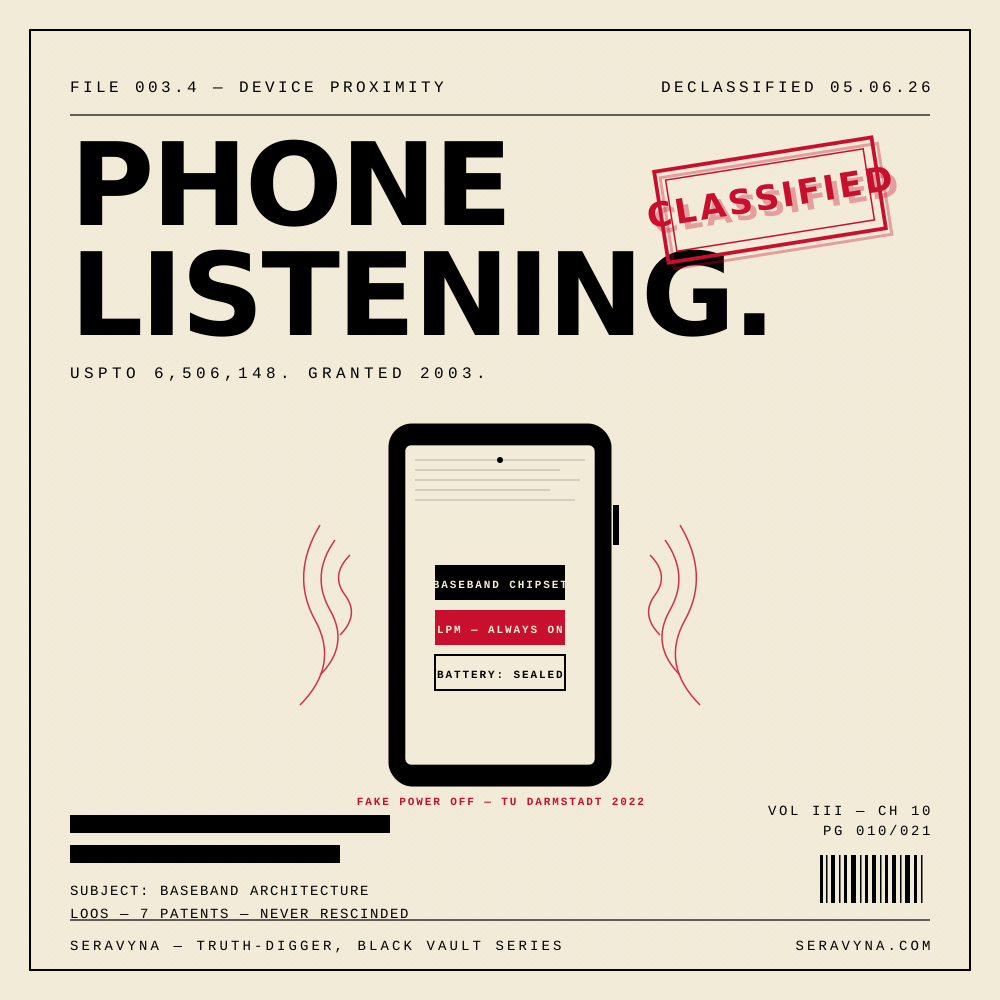
Your smartphone has a separate, second processor inside it called the baseband chipset. That chipset operates on its own firmware, runs independently of the main operating system you interact with, and continues transmitting low-power radio-frequency signals when the screen is off, when the phone is in airplane mode, and on most modern devices, after you press the power button. The baseband chipset is what handles your cellular connection. It is also what makes your phone, in any meaningful security sense, a device that is never actually off until the battery is physically removed. Modern smartphones have sealed, non-removable batteries.
That is the part that is documented in peer-reviewed academic research, in the firmware engineering literature, and in the patents and standards that govern how every modern smartphone is designed to function. Frequency Cage, Book Three of the 20-volume Black Vault Series, documents this architecture in chapter ten, alongside US Patent 6,506,148 (the patent granted in 2003 that describes a method for manipulating the human nervous system through electromagnetic fields emitted from screens), the Havana Syndrome neuroimaging findings published by the National Academies of Sciences in 2020, and the design history of the modern non-removable battery.
In this post I want to walk you through what the documented research actually shows about what your phone is doing while you sleep next to it, why a 2022 paper from the Technical University of Darmstadt called the iPhone's shutdown function a "fake power off", what US Patent 6,506,148 actually says about the legal basis for a device that can edit your nervous system through a screen, and what Frequency Cage documents about why all of this fits together as one architecture rather than as a coincidence of unrelated engineering decisions.
What The Mainstream Research Actually Shows
Let me put the documented baseline on the table first, because the credibility of everything that follows depends on the science being airtight.
A 2022 paper from the Technical University of Darmstadt, Evil Never Sleeps: When Wireless Malware Stays On After Turning Off iPhones, documented that iPhones with iOS 15 and later contain Low Power Mode (LPM) functionality implemented in hardware. The Bluetooth chip, the Ultra-Wideband chip, and the NFC chip remain operational after the user has shut the phone down. The chips are hardwired to the Secure Element. The shutdown the user sees is a software shutdown. It is not a hardware power-off. The Darmstadt researchers concluded that on modern iPhones, the wireless chips can no longer be trusted to be turned off after shutdown.
A 2024 paper from researchers at the National University of Singapore, BaseMirror: Automatic Reverse Engineering of Baseband Commands, documented that the baseband processor in modern smartphones is a proprietary, mandatory, closed-source component supplied by Qualcomm, Samsung, or MediaTek. The paper describes the baseband as a "self-contained and highly independent system with numerous undisclosed functionalities." End users cannot inspect the firmware. End users cannot disable the baseband. The baseband operates whenever the phone has power.
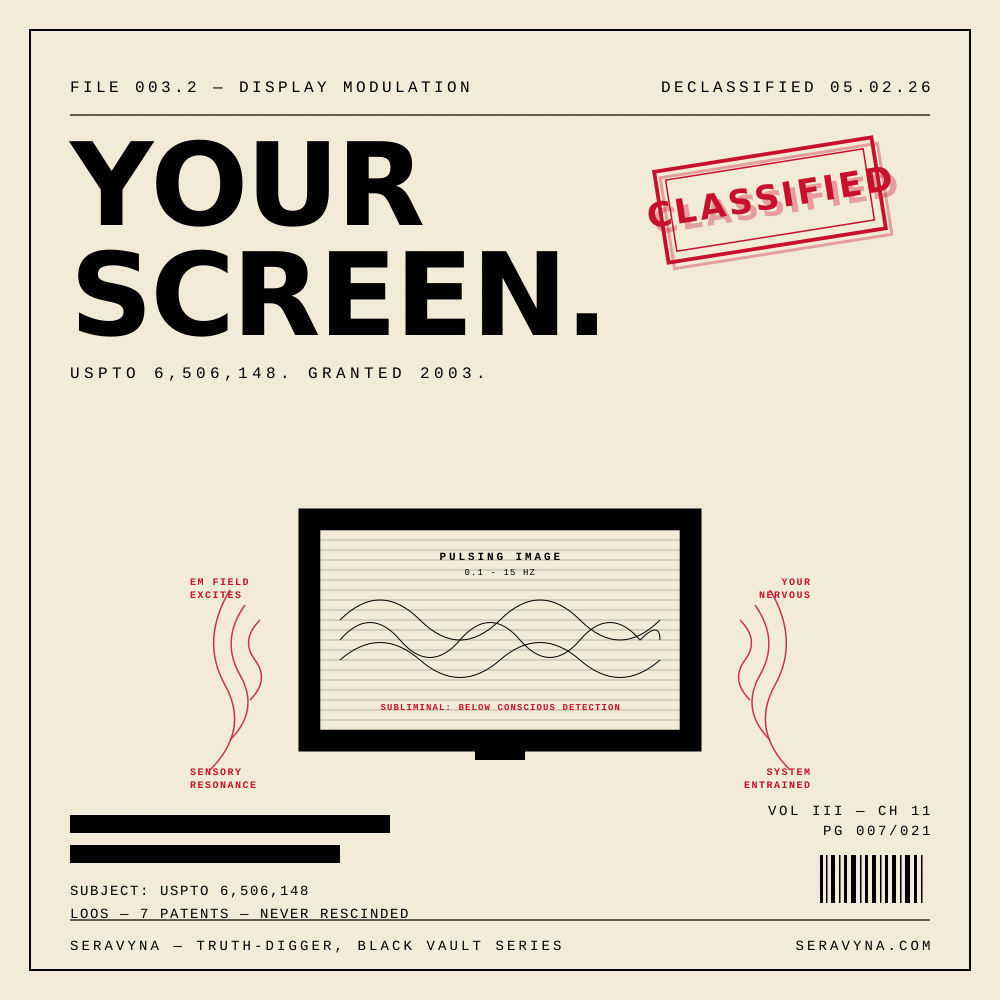
US Patent 6,506,148, titled Nervous System Manipulation by Electromagnetic Fields from Monitors, was granted to inventor Hendricus G. Loos by the United States Patent and Trademark Office on January 14, 2003. The patent describes a method for manipulating the nervous system of a subject located near a monitor by pulsing the displayed image at frequencies between 0.1 Hz and 15 Hz, frequencies that the patent's documentation states will excite "sensory resonances" in the subject. The pulsing can be embedded in program material or overlaid by modulating the video stream. The patent is real. It was examined by the patent office. It was granted. It has never been rescinded.
What the documented research has established about the device in your hand:
The baseband chipset is a separate, closed-source processor that runs independently of your operating system, has access to your microphone and your location data, and cannot be disabled by the user
Airplane mode does not stop baseband transmission. It stops the user-facing radio interface. The baseband continues to ping cellular, Bluetooth, and Wi-Fi infrastructure at intervals between 8 and 45 seconds
iPhone "shutdown" since iOS 15 is a software shutdown only. Bluetooth, UWB, and NFC chips remain hardwired to the Secure Element and continue operating in Low Power Mode
Sealed, non-removable batteries are now the design standard across Apple, Samsung, Google, and most other major manufacturers. The consumer rationale is "waterproofing and slim form factor". The operational consequence is that users cannot physically interrupt the device's power supply
US Patent 6,506,148 has never been rescinded and is one of seven patents granted to Hendricus G. Loos describing methods for manipulating the human nervous system through electromagnetic fields
That last point is the one most coverage skips. The patent is twenty-three years old. It is not theoretical. It describes a working method that was examined by patent attorneys and granted by the USPTO. The patent's existence is not evidence that the method has been deployed. The patent's existence is evidence that the method works well enough to satisfy a patent examiner that it is novel, non-obvious, and useful.
The question the documented record does not answer is what the method has been used for in the twenty-three years since the patent was granted.
The Question Mainstream Coverage Skips
Here is the part that becomes harder to dismiss the longer you sit with it.
The mainstream framing of each of these elements treats them as separate engineering decisions made for separate reasons. The non-removable battery is for waterproofing. The baseband chipset is for cellular reliability. The hardwired Bluetooth in iOS 15 is for Find My functionality. The Loos patents are a curiosity from an eccentric physicist whose work was never commercialized.
"On modern iPhones, wireless chips can no longer be trusted to be turned off after shutdown. This poses a new threat model... LPM is significantly more stealthy than a fake power off that only disables the screen."
I want you to read that twice.
The phone you sleep next to has a hardware-level function the academic security literature describes as a "fake power off". The function exists on every iPhone manufactured since 2021. The function cannot be disabled by software. The chips that remain on are the chips that handle wireless transmission and proximity detection.
If each of these elements existed in isolation, the mainstream framing would be defensible. Sealed batteries are a consumer choice. Closed-source baseband is a vendor licensing reality. Hardwired LPM is a Find My feature. Loos's patents are a quirk of patent law that grants 0.1-15 Hz pulsed-image patents to whoever files for them.
The framing that treats these as unrelated assumes the engineering decisions converged by accident. The framing in Frequency Cage asks what the architecture looks like if the convergence is not accidental. A device that cannot be powered off without removing its battery, that has a battery that cannot be removed, that contains a closed-source chipset that runs independently of the user's operating system, that has been the subject of patents granting methods for manipulating the human nervous system through its screen, is a device whose architecture aligns with the requirements of an always-on monitoring and influence system regardless of whether each individual engineering decision was made with that purpose in mind.
The documented engineering decisions are real. The convergence of the engineering decisions is real. The interpretation of whether the convergence is coincidental or designed is where the framework in Frequency Cage diverges from the mainstream account.
What The Loos Patent Actually Says
The most important sentence in US Patent 6,506,148 is the one that names the frequency range. The patent's claims describe a method that operates by pulsing the displayed image at frequencies between approximately 0.1 Hz and 15 Hz. This frequency range is significant for two specific reasons.
The lower end of the range overlaps with the delta brainwave band (0.5-4 Hz), which is the dominant brainwave during deep sleep and is associated with the brain's recovery and memory consolidation processes. The middle of the range overlaps with the theta band (4-8 Hz), associated with deep relaxation, meditation, hypnotic states, and the moments before sleep onset. The upper end overlaps with the alpha band (8-13 Hz), associated with relaxed wakefulness, light meditation, and the state most receptive to suggestion.
The patent's documentation states that physiological effects have been observed in human subjects in response to electromagnetic field stimulation at frequencies near 0.5 Hz and 2.4 Hz. These are not random numbers. They are the frequencies that fall inside the documented brainwave bands associated with the most cognitively vulnerable states a human being experiences.
The patent's six related patents in the Loos portfolio cover:
US 6,167,304: Pulse variability in electric field manipulator (1999)
US 6,239,705: Intermittent electromagnetic stimulation of nerves (2001)
US 6,488,617: Method and device for producing a desired brain state (2002)
US 6,506,148: Nervous system manipulation by electromagnetic fields from monitors (2003)
US 6,729,337: Method and device for manipulating the nervous system (2004)
US 6,966,876: Methods and devices for inducing desired states of consciousness (2005)
US 7,255,672: Subliminal nerve stimulation device (2007)
Seven patents, granted across eight years, by a single inventor, describing seven different methods for manipulating the human nervous system through electromagnetic fields, granted by the United States Patent and Trademark Office and entered into the public record. The patents have not been rescinded. The methods they describe have not been declared infeasible by any subsequent USPTO action. The intellectual property the patents represent is, in the legal sense, valid and enforceable.
What that means is the architecture is documented. What it has been used for is not.
What the Framework I've Built Across the Series Actually Proposes
I want to be transparent about what's documented and what's mine.
What's documented in mainstream peer-reviewed sources:
The Technical University of Darmstadt 2022 paper documenting hardware-level LPM functionality on iPhones that cannot be disabled by software shutdown
The National University of Singapore 2024 paper documenting that baseband processors are closed-source, mandatory, and independently functional
US Patent 6,506,148 describing electromagnetic nervous system manipulation through screen pulsing at 0.1-15 Hz, granted January 14, 2003
The seven-patent Loos portfolio describing related methods, all granted between 1999 and 2007
The 2020 National Academies of Sciences report on Havana Syndrome, which concluded that pulsed radio-frequency energy was the most plausible cause of the documented neurological injuries to U.S. government personnel
The HAVANA Act of 2021, signed into U.S. law, authorizing federal compensation to government personnel injured by directed energy weapons
What's not in the mainstream record is the framework that interprets these documented elements as components of a single architecture rather than as separate phenomena that share only the property of involving electromagnetic fields. That part is what I lay out in Frequency Cage.
The framework proposes that the device you are reading this on is one node in a global infrastructure designed to maintain continuous proximity to the human nervous system, that the engineering decisions which converged to produce a non-removable, non-disable-able, closed-source, screen-emitting device aligned with the requirements of that infrastructure regardless of which engineers made which decisions for which stated reasons, and that the patents granted to Loos and others document the legal basis for the methods the infrastructure is capable of deploying. The book documents the full architecture across twenty chapters, with the deep-vault material on the operational signature of the system you cannot see, hear, or feel directly.
You don't have to accept the framework on my word. The Darmstadt paper is open access. The Loos patents are on the USPTO website. The baseband architecture documentation is in 3GPP technical specifications. The components are all in the public record. What I have done in Frequency Cage is put them in the same room and ask the question the mainstream coverage of each individual component does not.
Frequently Asked Questions
Is my phone actually listening when it's off?
The phone is not "off" in the engineering sense when you press the power button on most modern devices. On iPhones with iOS 15 or later, the Bluetooth, Ultra-Wideband, and NFC chips remain hardwired to the Secure Element and continue operating in Low Power Mode. On Android devices, the baseband chipset continues to operate independently of the user-facing operating system. Whether the device is "listening" in the sense of recording audio depends on what the closed-source baseband firmware is configured to do, which the user cannot inspect.
What does airplane mode actually do?
Airplane mode disables the user-facing cellular, Wi-Fi, and Bluetooth radio interfaces. It does not power down the baseband chipset. The Darmstadt 2022 paper and the firmware engineering literature both document that low-power transmission modes continue operating during airplane mode on most modern smartphones.
Is US Patent 6,506,148 real?
Yes. The patent was granted by the United States Patent and Trademark Office on January 14, 2003, to inventor Hendricus G. Loos. It is publicly accessible through Google Patents, Justia Patents, and the USPTO database. The patent has never been rescinded. It is one of seven patents granted to Loos describing methods for manipulating the human nervous system through electromagnetic fields.
Does the patent prove my phone is manipulating my nervous system?
No. The patent proves that a method for manipulating the nervous system through screen pulsing at 0.1-15 Hz was examined and granted by the USPTO. The patent does not prove that the method has been deployed in commercial smartphones. The framework in Frequency Cage argues that the architecture of modern smartphones is consistent with the deployment of such a method, but the documented record does not confirm deployment in any specific device.
Why are smartphone batteries non-removable?
The consumer rationale provided by manufacturers is waterproofing, slim form factor, and aesthetics. The operational consequence is that users cannot physically interrupt the device's power supply. The framework in Frequency Cage does not dispute the consumer rationale. It documents that the same design choice serves both the consumer rationale and the requirement of an always-on device, and that both purposes are served simultaneously by the same engineering decision.
What can I do about this?
The full mitigation discussion is in chapter twenty of Frequency Cage. The short version: physical signal blocking (Faraday pouches), keeping the device out of the bedroom at night, removing the device from your immediate body proximity during sleep, and treating the device as a continuously-transmitting object rather than as a tool you can put down. The architecture is real. The mitigations available to an individual user are limited but not zero.
Is this real or fiction?
It's investigative speculative nonfiction. The Darmstadt LPM paper, the Loos patents, the National Academies Havana Syndrome report, the 3GPP baseband specifications, and the design history of non-removable batteries are all real and verifiable. The framework that interprets these documented elements as components of a single architecture is the contribution made in Frequency Cage. Readers are encouraged to verify the sources themselves.
How does this connect to the rest of the Black Vault Series?
The smartphone architecture is documented across multiple books in the series. Frequency Cage (Book 3) documents the device-level architecture and the patent base. Soul Harvest (Book 4) documents what the data the device collects is used for after biological death. Sealed Sky (Book 2) documents the larger transmission infrastructure the device operates within. Beyond The Ice Wall (Book 1) maps the perimeter that contains the entire system. There Is No God (Book 5) documents the consciousness layer beneath all of it. You Were Never Real (Book 6) documents how the architecture installed the version of you that consents to the device. Books 7 through 20 are in development.
The smartphone architecture is documented across multiple books in the series. Frequency Cage (Book 3) documents the device-level architecture and the patent base. Soul Harvest (Book 4) documents what the data the device collects is used for after biological death. Sealed Sky (Book 2) documents the larger transmission infrastructure the device operates within. Beyond The Ice Wall (Book 1) maps the perimeter that contains the entire system. There Is No God (Book 5) documents the consciousness layer beneath all of it. You Were Never Real (Book 6) documents how the architecture installed the version of you that consents to the device. Books 7 through 20 are in development.
What Comes Next
Here's where I land on this.
The device you're reading this on is engineered such that you cannot turn it off without removing a battery you cannot remove. Inside it is a closed-source processor you cannot inspect, running firmware you cannot modify, transmitting at intervals you cannot detect, in frequency ranges that overlap with patents that describe methods for manipulating your nervous system through the screen you are looking at. The patents are real. The non-removable battery is real. The closed-source baseband is real. The hardware-level LPM is real. The peer-reviewed academic research describing all of these elements is real and is searchable in five minutes.
What is not documented anywhere in the mainstream record is why all of these elements converged in the same device at the same historical moment if the convergence was not designed. The mainstream interpretation says coincidence. The interpretation in Frequency Cage says architecture.
I'm not asking you to throw your phone away. I use mine. I'm asking you to look at what the device actually is, in the documented engineering sense, rather than what the marketing tells you it is. A device that cannot be turned off, that cannot be physically interrupted, that contains processors you cannot inspect or disable, that emits in frequency ranges patented for nervous system manipulation, is not the device the consumer marketing describes. It is something else, regardless of whether anyone is currently using it for what the architecture would permit.
The architecture is what the architecture is. What it does next is a separate question, and the answer to that question is not in the engineering literature.
It's in the operational record we don't have access to.
Frequency Cage, Book Three of the 20-volume Black Vault Series, is available now on Amazon. The first six books are out. Fourteen more are in development. The full architecture of the device in your hand is in chapter ten. The seven-patent Loos portfolio is in chapter eleven. The mitigation protocol is in chapter twenty. The deep vault addendum is what no civilian was supposed to see. Begin with Beyond The Ice Wall if you're new to the series. You can browse the full Black Vault Series on Amazon here.
Responses
What are your thoughts on this post?