



The Moon Photos Are Fake
I want to start with the number, because the number is the receipt the entire investigation rests on.
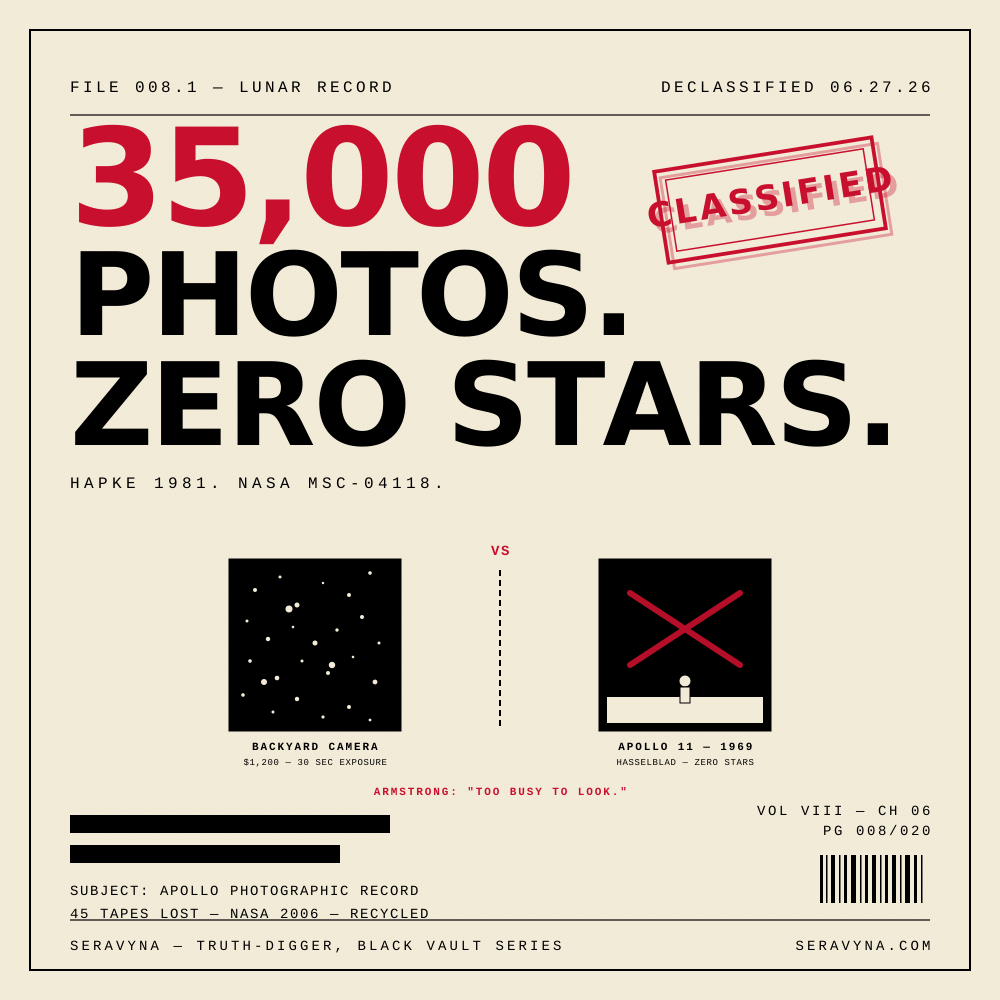
Thirty-five thousand photographs. Six missions. Eighty hours on the lunar surface across twelve astronauts. Hasselblad 500EL medium-format cameras. Zeiss Biogon lenses. Kodak SO-168 thin-base color reversal film. The most extensively documented record of extraterrestrial human activity in human history.
Zero stars.
Not a faint scattering. Not a reduction visible only to trained astrophotographers. Not a dim suggestion of the brightest stellar objects. Zero. Across thirty-five thousand photographs from six missions, no astronaut on the surface of the Moon ever took a single photograph of the airless stellar sky above them. They were given the most extraordinary photographic opportunity in the history of human visual experience, in an environment with no atmospheric scattering and no light pollution, with equipment fully capable of long exposures, across eighty hours of surface activity, and they returned with thirty-five thousand photographs of rocks, dust, equipment, each other, and the Earth rising over the lunar horizon.
When asked at the post-mission press conference what the stars looked like from the lunar surface, the Apollo 11 crew said they had been too busy to notice.
That is the documented record. That is what NASA's own archive at nasa.gov says happened.
NASA Secrets, Book Eight of the 20-volume Black Vault Series, documents this and three other categories of evidence that, taken together, produce a forensic conclusion the photographic record itself supports: that the Apollo lunar surface photographic and film record was not produced in the environment in which it is claimed to have been produced. The book is built from peer-reviewed optical physics, NASA's own technical documentation, the publicly available astronaut press conference record, and composite accounts from professional analysts in optical forensics, underwater cinematography, radar tracking, and structural propulsion who applied their professional methodologies to the Apollo record across years of independent work.
In this post I want to walk you through what the absence of stars actually proves, what the shadow geometry across the Apollo photographic record reveals about the lighting environment that produced it, why the world's largest indoor swimming pool sits inside NASA's astronaut training facility in Houston, and what NASA Secrets documents about why the most expensive human spaceflight program in NASA's history, the Artemis program, has spent forty-three billion dollars across more than a decade and has not sent a single crewed mission beyond low Earth orbit.
What The Documented Record Actually Shows
Let me put the receipts on the table first, because the credibility of everything that follows depends on the evidence being verifiable in mainstream sources.
The Apollo lunar surface photographic record comprises approximately 35,000 photographs taken across six missions between July 1969 and December 1972. The equipment is documented in NASA's own Technical Note MSC-04118: Hasselblad 500EL camera bodies, Zeiss Biogon 60mm f/5.6 lenses, Kodak SO-168 thin-base color reversal film manufactured specifically for NASA with an exposure index of approximately 64 ASA. The standard surface exposure was approximately 1/250th of a second at f/11. The cameras were fully capable of long exposures.
What the documented optical physics establishes about the lunar surface lighting environment:
The Moon has no atmosphere. It cannot scatter sunlight to produce diffuse ambient illumination
The lunar surface reflects approximately 12% of incident sunlight, per peer-reviewed bidirectional reflectance research published by Hapke (1981) in the Journal of Geophysical Research
There is one light source on the lunar surface: the Sun. Shadows should be hard-edged, parallel, and converge on a common vanishing point consistent with a single distant point source
Stars from the lunar surface would be the most extraordinary photographic subject ever made available to a human being. No atmosphere means no light scattering, no extinction, no twinkle. The Milky Way visible as individual resolved stars. Pure stellar colors. The optical conditions are unrepeatable on Earth at any altitude
The Apollo astronauts had cameras capable of capturing it. Long exposure on Hasselblad film does not require electricity or computer control. Open the shutter. Wait thirty seconds. Close it. Advance the film
They never did. Not once across 80 hours of combined surface activity. Not in any of the 35,000 photographs
The Apollo program produced the most photographed event in human history and contained zero photographs of the stellar sky from the lunar surface. The standard NASA explanation, that the cameras were set for daylight exposure on the sunlit surface, is technically correct about the surface photographs themselves and does not address why no star photographs were ever taken.
That last point is the one mainstream coverage skips. NASA's explanation answers the wrong question. The question is not why the existing surface photographs do not show stars. The question is why no astronaut, across six missions and 80 hours of surface time, ever pointed a Hasselblad at the sky for thirty seconds.
The Apollo photographic record contains 35,000 photographs of dust and equipment. It contains zero photographs of the one thing that could not be produced anywhere else on Earth or replicated under any lighting conditions any studio in the world possessed in 1969 or possesses now.
The Question Mainstream Coverage Skips
Here is the part that becomes harder to dismiss the longer you sit with it.
Across the Apollo photographic record, peer-reviewed optical physics applied to the documented images produces three additional findings that the standard NASA narrative does not address:
Fill light in shadowed areas. The shadowed regions of multiple Apollo photographs show illumination levels significantly above what the documented 12% lunar surface reflectance can account for. On a single-source-illuminated surface with no atmosphere, shadow areas should be near-black, lit only by reflected light from the surrounding terrain. The fill light levels in the documented Apollo photographs are consistent with a secondary light source or with diffuse illumination produced by atmospheric scattering, neither of which is physically possible on the lunar surface.
Divergent shadow geometry. Shadows from different objects in the same frame in multiple Apollo photographs do not converge on a common vanishing point consistent with a single distant point light source. They diverge. Divergent shadow geometry is a documented characteristic of multiple light sources at different positions, which is the lighting arrangement standard in film studio production. It is not physically possible on the Moon.
The 2006 acknowledgement of lost tapes. In 2006, NASA publicly acknowledged that the original slow-scan television recordings of the Apollo 11 lunar surface activity had been lost. Approximately forty-five reels were identified as the likely location of the original recordings. All forty-five had been recycled and overwritten during a magnetic tape recycling program in the 1970s and 1980s. Not one reel of the highest-quality primary record of the most important engineering achievement in human history survived.
"Astronaut Neil Armstrong, command pilot for the Apollo 11 Moon Landing Mission... A reporter asked what the stars looked like from space and from the lunar surface. Armstrong and Aldrin both indicated they had not paid particular attention. Armstrong said they had been too busy to look at stars."
I want you to read that twice.
The most experienced test pilots in American aviation history, trained in celestial navigation, on the most extraordinary journey ever undertaken by a human being, stood on the surface of an airless world with the Milky Way overhead in unrepeatable clarity, and they had been too busy to look. Then they returned with thirty-five thousand photographs of rocks and zero photographs of the sky.
The mainstream interpretation treats each of these findings as a separate curiosity with a separate technical explanation. The fill light is reflected from the suits. The divergent shadows are an optical illusion produced by uneven terrain. The lost tapes were a routine recycling error. The astronaut deflections were the natural reticence of military pilots. Each individual explanation is technically defensible. The framework in NASA Secrets asks what the pattern looks like if the explanations are not unrelated.
A photographic record produced under documented lighting conditions inconsistent with the stated shooting environment, accompanied by the loss of all primary high-resolution recordings, accompanied by a uniform astronaut deflection pattern on questions about visual experience, accompanied by the absence of any photographs of the one subject that could not have been produced in a studio, is the operational signature of a documentary record produced in an environment other than the one it is claimed to have been produced in.
The documented optical physics is real. The documented archival pattern is real. The documented astronaut press conference record is real. The interpretation of whether the convergence of these documented elements reflects coincidence or design is where the framework in NASA Secrets diverges from the mainstream account.
The Pool Stage
The single most damaging piece of evidence in NASA Secrets is not in Chapter 4 or Chapter 6. It is in Chapter 5. It concerns the world's largest indoor swimming pool.
The pool is not in a hotel or a theme park or an Olympic training facility. It is in Houston, Texas, inside a building operated by NASA called the Neutral Buoyancy Laboratory, located at the Sonny Carter Training Facility adjacent to the Johnson Space Center. Its dimensions are publicly documented in NASA's own facility documentation: 202 feet long, 102 feet wide, 40 feet deep. It holds approximately 6.2 million gallons of water. It contains full-scale mockups of the International Space Station modules.
NASA's stated purpose for the facility is astronaut training. Astronauts practice spacewalk procedures by managing their buoyancy in water, using weighted suits to simulate the microgravity environment they will encounter in orbit. The simulation is imperfect, NASA acknowledges. Water provides resistance that space does not. Suits behave differently in water than in vacuum. But as a training tool, NASA presents neutral buoyancy as the best available simulation of microgravity.
The forensic problem is that genuine microgravity footage and underwater footage produced in a neutral buoyancy facility have specific, documented optical and physical signatures that distinguish them. The signatures are not subtle to professional underwater cinematographers and dive operations supervisors. The signatures include:
Bubble behavior. Air bubbles in water always rise. In genuine microgravity, gas released forms expanding spheres without directional bias. Across multiple ISS EVA broadcasts, small objects can be observed moving upward in trajectories consistent with air bubbles in water at moments consistent with suit ventilation events
Suit damping during movement transitions. In genuine microgravity, the inertia of a pressurized suit produces a characteristic ripple of continued motion when the astronaut stops moving. In water, viscous drag arrests motion quickly with a characteristic damping pattern. The damping patterns visible across multiple ISS EVA sequences are the viscous-medium signature, not the inertial signature
Helmet visor reflections. Visor reflections from genuine EVA conditions should show the black of space and the curve of the Earth. Visor reflections from underwater conditions show the lighting environment of the pool: overhead lighting arrays, structural elements of the facility. In at least one documented ISS EVA sequence, visor reflection analysis at high magnification shows a rectangular grid of overhead lighting at a scale and geometry consistent with the documented ceiling structure of the Neutral Buoyancy Laboratory
The public explanation for why astronauts train in the pool is coherent. The question NASA Secrets documents is why pool footage carries the optical and physical signatures of the actual broadcast EVA record rather than appearing only in publicly designated training footage.
A facility that holds 6.2 million gallons of water, contains full-scale mockups of the International Space Station, and operates under publicly documented training and production protocols, is not built for rehearsal alone. Rehearsal does not require the largest indoor pool in the world. Rehearsal does not require a production pipeline.
The pool is the stage. The book documents what the stage produces.
What the Framework I've Built Across the Book Actually Proposes
I want to be transparent about what's documented and what's mine.
What's documented in mainstream peer-reviewed sources and NASA's own archive:
The complete Apollo photographic catalog, NASA Technical Note MSC-04118 and the public photographic archive
The peer-reviewed lunar surface reflectance research, Hapke 1981 in the Journal of Geophysical Research and Cornette and Shanks 1992 in Applied Optics
The 2006 NASA acknowledgement that the original Apollo 11 slow-scan television tapes had been recycled and overwritten
The Apollo 11 post-mission press conference transcript, in NASA's own archive at nasa.gov
The Neutral Buoyancy Laboratory facility documentation, NASA Johnson Space Center JSC-63400
The 2023 NASA Office of Inspector General report on Artemis program costs and schedule slippage
The 2023 Government Accountability Office report on Artemis cost and schedule risks
The Apollo command module radiation dosimetry data showing reported crew exposures of 2-11 millisieverts across full mission durations, inconsistent with documented particle energies and flux levels in the Van Allen belt environments transited by the documented trajectories per NCRP Report No. 132 and NASA Technical Publication TP-2005-213164
What's not in the mainstream coverage is the framework that interprets these documented elements as components of a single sustained operational architecture rather than as a series of independent technical questions with independent explanations. That part is what I lay out in NASA Secrets.
The framework proposes that the Apollo lunar surface photographic record was not produced on the lunar surface, that the engineering and budget architecture of the Artemis program reflects the operational constraint that the ceiling the Apollo program is claimed to have exceeded has not in fact been exceeded, that the Neutral Buoyancy Laboratory functions as a production facility as well as a training facility, and that the documented pattern across the agency's archival behavior, its astronaut communication protocols, and its post-Apollo program schedule is the operational signature of an institutional architecture maintaining a sustained narrative that the underlying engineering reality does not support.
The book documents the full architecture across seventeen chapters with the deep-vault material on what the ceiling is, who enforces it, and what it has been concealing for sixty years.
You don't have to accept the framework on my word. The Apollo photographic catalog is on NASA's own website. The press conference transcripts are in the NASA history archive. The peer-reviewed optical physics is in the journals named above. The Inspector General reports are public documents. The components are all in the public record. What I have done in NASA Secrets is put them in the same room and ask the question NASA's institutional charter is not designed to answer.
Frequently Asked Questions
Are the Apollo photographs really missing all stars?
Yes. Across the approximately 35,000 photographs in the Apollo lunar surface record, there are zero photographs of the stellar sky from the lunar surface. NASA's standard explanation is that the cameras were set for daylight exposure and could not capture stars simultaneously with the sunlit surface. The explanation does not address why no dedicated long-exposure star photographs were taken across 80 hours of combined surface activity by astronauts using cameras capable of long exposures.
Did NASA really lose the original Apollo 11 tapes?
Yes. NASA publicly acknowledged in 2006 that the original slow-scan television recordings of the Apollo 11 lunar surface activity had been lost. Approximately 45 reels were identified as the likely location and all had been recycled and overwritten during a magnetic tape recycling program in the 1970s and 1980s.
Did Neil Armstrong really say he was "too busy" to look at the stars?
Yes. The exact context appears in the Apollo 11 post-mission press conference and the 30th anniversary press conference, both archived on NASA's own website. When asked about the visual environment of the lunar surface, the Apollo 11 crew consistently cited their workload and operational schedule rather than describing the visual experience.
What about the Van Allen radiation belts?
The NASA dosimetry data for the Apollo missions reports crew exposures of 2 to 11 millisieverts for the entire mission duration, lower than annual background radiation at sea level. The documented particle energies and flux levels in the Van Allen belt environments transited by Apollo trajectories, per the National Council on Radiation Protection and Measurements Report No. 132 and NASA Technical Publication TP-2005-213164, are not consistent with producing exposures in this range given the documented aluminum-alloy shielding of the Apollo command module.
Is the Neutral Buoyancy Laboratory real?
Yes. The NBL is a real NASA facility at the Sonny Carter Training Facility in Houston, Texas, adjacent to the Johnson Space Center. Its dimensions, capacity, and operational protocols are publicly documented in NASA Johnson Space Center documentation JSC-63400. The framework in NASA Secrets argues that the facility's production function operates alongside its acknowledged training function.
Why has the Artemis program not landed humans on the Moon?
The Artemis program has consumed approximately 43 billion dollars across more than a decade of development. Per the 2023 NASA Office of Inspector General report and the 2023 Government Accountability Office report, the program has not sent a single crewed mission beyond low Earth orbit. The framework in NASA Secrets argues that the schedule slippage and budget overruns reflect an operational constraint that the engineering documentation does not fully describe.
Is this real or fiction?
It's investigative speculative nonfiction. The photographic catalog, the press conference transcripts, the peer-reviewed optical physics, the Inspector General reports, the GAO assessments, and the publicly documented facility specifications are all real and verifiable. The framework that interprets these documented elements as components of a sustained institutional architecture is the contribution made in NASA Secrets. Readers are encouraged to verify the sources themselves.
How does this connect to the rest of the Black Vault Series?
The architecture documented in NASA Secrets (Book 8) connects to Beyond The Ice Wall (Book 1) on the question of the perimeter, Sealed Sky (Book 2) on the question of what is above the perimeter, Frequency Cage (Book 3) on the signal infrastructure, Soul Harvest (Book 4) on the digital identity layer, There Is No God (Book 5) on the consciousness layer, and You Were Never Real (Book 6) on the identity installation. Books 9 through 20 are in development.
Yes. Across the approximately 35,000 photographs in the Apollo lunar surface record, there are zero photographs of the stellar sky from the lunar surface. NASA's standard explanation is that the cameras were set for daylight exposure and could not capture stars simultaneously with the sunlit surface. The explanation does not address why no dedicated long-exposure star photographs were taken across 80 hours of combined surface activity by astronauts using cameras capable of long exposures.
Is this real or fiction?
What Comes Next
Here's where I land on this.
Thirty-five thousand photographs from six missions. Zero photographs of the stellar sky. A peer-reviewed optical physics record showing fill light and shadow geometry inconsistent with single-source illumination on an airless surface. A publicly acknowledged loss of the original highest-quality television recordings of the most important engineering achievement in human history. A consistent astronaut deflection pattern on questions about visual experience. A 6.2-million-gallon indoor pool with full-scale ISS mockups operating in Houston. A forty-three-billion-dollar successor program that has spent more than a decade and has not sent a single crewed mission beyond low Earth orbit.
That is the documented record. That is what NASA's own archive, the peer-reviewed optical physics literature, the Inspector General reports, and the publicly available press conference transcripts say happened.
What is not documented anywhere in the mainstream coverage is why a documentary record produced under the most prestigious institutional auspices in the world, with the highest engineering budget in human history, with the most decorated test pilots America had produced, contains zero photographs of the one subject that could not have been produced anywhere else and that the airless lunar surface was uniquely positioned to deliver. The mainstream interpretation says the astronauts were busy. The interpretation in NASA Secrets says the photographs do not exist because the cameras were not where the record claims they were.
I'm not asking you to dismiss the achievement. I'm asking you to look at what the documented record actually contains, and at what it conspicuously does not contain, and at the pattern that emerges across six decades of subsequent program behavior. The pattern is not noise. The pattern is the operational signature of a sustained institutional architecture that began in 1969 and has not changed shape in any of the six administrations since.
The system has counted on most people knowing the Apollo program through the same fifteen iconic photographs and the same five mission narratives, never sitting down with the photographic catalog as a whole, never asking what is missing from it, never asking why what is missing from it could not have been produced anywhere else. The catalog is in the archive. The optical physics is in the journals. The press conferences are in NASA's own historical record.
What you do with that information is your decision.
I hope you decide to look.
NASA Secrets, Book Eight of the 20-volume Black Vault Series, is available now. The first eight books are out. Twelve more are in development. The full forensic analysis of the Apollo photographic record is in chapters four and six. The Pool Stage is in chapter five. The Artemis ceiling is in chapter ten. The deep vault addendum is what no civilian was supposed to see. Begin with Beyond The Ice Wall if you're new to the series. You can browse the full Black Vault Series on Amazon here.
Seravyna ♛
Responses
What are your thoughts on this post?