





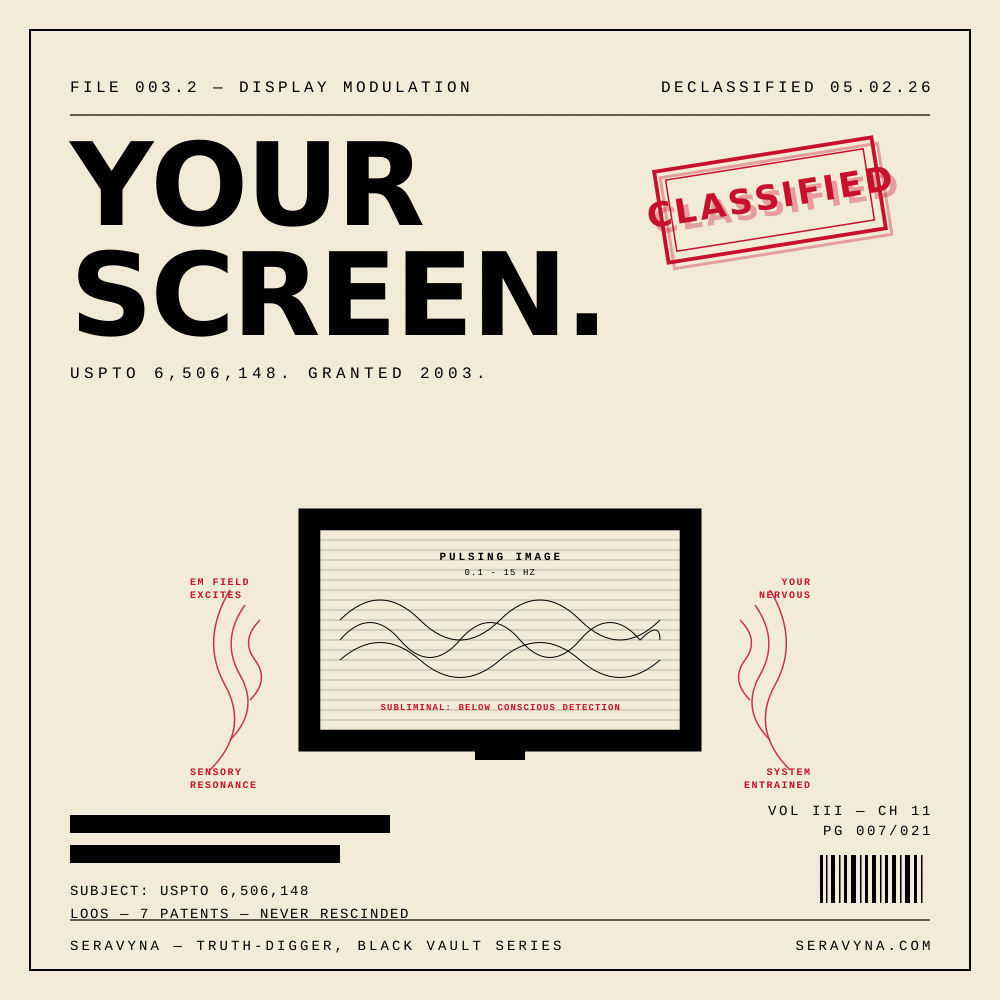



US Patent 6,506,148, granted by the United States Patent and Trademark Office on January 14, 2003, describes a method for manipulating the human nervous system by pulsing the images displayed on a computer monitor or television screen at specific low frequencies, designed to excite sensory resonances in the brain of any subject located near the screen.
The patent is real. It was filed in May 2001. It was examined by USPTO patent examiners. It was granted. It has never been rescinded. The inventor's name is Hendricus G. Loos, a Dutch-born American physicist with a degree from Delft University of Technology and a career spanning Plasmadyne, Douglas Aircraft, the University of California, and the Advanced Research Labs.
Loos filed at least seven related patents on nervous system manipulation by electromagnetic means between 1999 and his death in 2017. The 2003 patent is one of seven federal documents that describe, in formal patent language, methods for manipulating human neurological function through external electromagnetic fields, including fields radiated by ordinary consumer electronic displays.
In this post I want to walk you through what the patent actually claims, what the documented neurology behind it actually says, what Frequency Cage, Book Three of the 20-volume Black Vault Series, documents about how this patent connects to the broader screen-delivery infrastructure, and why the existence of a granted federal patent is a stronger argument than any speculation about classified programs ever could be.
What Patent 6,506,148 Actually Says
Let me put the document on the table first, because the source quality matters and most people who hear about this patent never read the actual filing.
US Patent 6,506,148 B2, titled Nervous System Manipulation by Electromagnetic Fields from Monitors, was filed by Hendricus G. Loos on June 1, 2001 and granted by the USPTO on January 14, 2003. The patent's abstract describes the invention in clinical, technical language:
"Physiological effects have been observed in a human subject in response to stimulation of the skin with weak electromagnetic fields that are pulsed with certain frequencies near ½ Hz or 2.4 Hz, such as to excite a sensory resonance. Many computer monitors and TV tubes, when displaying pulsed images, emit pulsed electromagnetic fields of sufficient amplitudes to cause such excitation. It is therefore possible to manipulate the nervous system of a subject by pulsing images displayed on a nearby computer monitor or TV set."
What the patent specifies in the operational claims:
The mechanism uses image pulsing at frequencies between 0.1 Hz and 15 Hz, with particular effectiveness at frequencies near 0.5 Hz and 2.4 Hz
The pulsing can be embedded directly into the program material (e.g., the broadcast or streamed content itself)
The pulsing can be overlaid through modulation of either the RF signal or the video signal feeding the display
The image pulsing can be implemented through a simple computer program running on the monitor's host system
The electromagnetic fields generated are sufficient to excite sensory resonances at amplitudes the human nervous system measurably responds to
The pulsing can be subliminal, meaning the visual intensity of the modulation can be below the threshold of conscious visual detection while still producing the electromagnetic field effect
That last specification is the one that takes a moment to fully process. The patent describes a method that can affect the nervous system of a subject without the subject perceiving any visual change in what they are watching.
The U.S. Patent and Trademark Office examined this claim and granted the patent. That is a federal agency on the public record acknowledging that the described method is novel, non-obvious, and useful, the three legal criteria for a patent grant. The federal government did not say the technology works conclusively. The federal government said the method described is patentable as an invention, which is itself a documented claim about what the technology can do.
The Other Six Patents Most Coverage Skips
The 2003 patent is not Loos's only patent in this space. The full Loos patent portfolio at the United States Patent and Trademark Office includes:
US 5,800,481 (1998), Thermal Excitation of Sensory Resonances, describing nervous system stimulation through thermal pulsing
US 6,017,302 (2000), Subliminal Acoustic Manipulation of Nervous Systems, describing acoustic methods of nervous system manipulation
US 6,238,333 (2001), Remote Magnetic Manipulation of Nervous Systems, describing manipulation through external magnetic fields
US 6,506,148 (2003), the screen-based patent that anchors this post
US 6,729,337 (2004), Method and Device for Producing a Desired Brain State, describing techniques for inducing specific neurological states
US 7,255,439 (2007), Subliminal Display Modulation, expanding on the screen-based mechanism
US 7,547,279 (2009), the Nervous System Manipulation Through Sensory Resonance extension
Seven federal patents. One inventor. Granted across an eleven-year span. All describing methods of external manipulation of the human nervous system through electromagnetic, acoustic, magnetic, or visual means. All of them publicly searchable. All of them still in the federal patent record.
The pattern is significant for a single reason most people miss. A patent costs roughly fifteen thousand dollars to prosecute through the USPTO when filed by an individual inventor with proper legal representation. Seven granted patents represents a substantial cumulative investment. The investment is documented. The patents are documented. The mechanisms claimed are documented. The institutional rationale for that level of investment in an ongoing patent program for nervous system manipulation methods is something the public record does not explain.
The Documented Neurology Behind the Patent
To understand why the patent claims are not as far-fetched as they might initially sound, you need to understand a documented neurological phenomenon that mainstream peer-reviewed neuroscience has been studying for over fifty years.
The phenomenon is called frequency-following response, sometimes also called steady-state visual evoked potential or photic driving. It is the documented capacity of the human brain to entrain its electrical activity to the frequency of a rhythmic external stimulus, including light flicker.
What the peer-reviewed research has established:
Photic driving was first systematically documented in the 1940s and 1950s by EEG researchers including Walter Grey
The human visual cortex measurably synchronizes to flicker frequencies between 1 and 50 Hz, with the strongest entrainment in the alpha range (8 to 12 Hz) and theta range (4 to 8 Hz)
The entrainment effect propagates beyond the visual cortex to other brain regions including the prefrontal cortex and limbic system, as documented in functional neuroimaging studies
The same effect is observable below the threshold of conscious flicker detection, meaning sub-perceptual flicker can still drive measurable cortical responses
The mechanism is established enough that audio-visual entrainment devices are sold commercially as relaxation and meditation aids, with Health Canada and FDA regulatory frameworks governing their classification
The neurology behind Loos's patent is not speculative. The application of that neurology to consumer monitors, with the explicit goal of manipulating the nervous system of subjects who do not consent or know they are being manipulated, is what the patent specifically claims. The neurology is mainstream. The application is the patent.
What the Framework I've Built Across the Series Actually Proposes
I want to be transparent about what's documented and what's mine.
What's documented in the public record:
US Patent 6,506,148, granted in 2003, describing nervous system manipulation through computer monitor and television screen image pulsing
The seven-patent Loos portfolio at the USPTO covering nervous system manipulation through multiple electromagnetic, acoustic, and visual methods
The peer-reviewed neuroscience of frequency-following response, photic driving, and steady-state visual evoked potentials
The documented research on subliminal flicker showing measurable cortical responses below the threshold of conscious detection
The technical specification of modern OLED, LED, and LCD displays which routinely refresh at frequencies in the 60-240 Hz range and contain sub-pixel modulation circuits capable of fine-grained pulsing
The fact that streaming video platforms have full, low-level control over the frame-by-frame intensity of every pixel they deliver to your screen
What's not in the public record is the framework that connects these documented elements into an architecture rather than a coincidence. That part is what I lay out in Frequency Cage.
The framework proposes that the existence of a granted federal patent for a specific method does not prove the method is being deployed, but it does prove three things the public record cannot otherwise establish: that the method works (otherwise the patent examiner would not have granted it as useful), that someone invested significant resources to secure exclusive legal rights to it (otherwise the patent would not have been filed and prosecuted), and that the technical infrastructure required to deploy it (consumer monitors with frame-level pulsing capability) has become ubiquitous in every household in the developed world over the past two decades. The architecture is in place. The patent claims are documented. The public record contains every component except the operational confirmation.
You don't have to accept the framework on my word. The patent is searchable. The neuroscience is peer-reviewed. The display technology is in front of you right now as you read this. The components are all in the public record. What I have done in Frequency Cage is put them in the same room.
Frequently Asked Questions
Did the U.S. government really grant a patent for manipulating the nervous system through TV screens?
Yes. US Patent 6,506,148, titled Nervous System Manipulation by Electromagnetic Fields from Monitors, was filed by Hendricus G. Loos on June 1, 2001 and granted by the USPTO on January 14, 2003. The patent is publicly searchable on Google Patents, the USPTO database, and Justia Patents. The patent has never been rescinded.
Who was Hendricus G. Loos?
Hendricus G. Loos was a Dutch-born American research physicist with a degree from Delft University of Technology. His career included positions at Plasmadyne Corp., Giannini Scientific Corp., Douglas Aircraft Co., the Advanced Research Labs, the University of California (as Associate Professor of Physics), and his own Laguna Research Laboratory and Cuewave Corporation. Loos was born December 18, 1925 and died January 29, 2017. He filed at least seven patents on nervous system manipulation by electromagnetic means between 1998 and 2009.
What does the patent actually claim?
The patent claims that pulsing the image displayed on a computer monitor or television at specific low frequencies (0.1 Hz to 15 Hz, with particular effectiveness near 0.5 Hz or 2.4 Hz) emits electromagnetic fields capable of exciting sensory resonances in the nervous system of any subject near the screen. The patent specifies the pulsing can be embedded in the program material itself, can be overlaid through video signal modulation, and can be implemented at intensities below the threshold of conscious visual detection.
Has the technology actually been deployed?
The publicly available record does not include confirmed evidence that this specific patent has been deployed in commercial broadcast or streaming systems. What the public record does include is the patent itself, the supporting peer-reviewed neuroscience on frequency-following response, the ubiquity of display hardware capable of implementing the technique, and the seven-patent portfolio Loos accumulated in this space. Whether deployment has occurred is the question the framework in Frequency Cage addresses.
Is the underlying neuroscience real?
Yes. The frequency-following response, photic driving, and steady-state visual evoked potential are mainstream peer-reviewed neuroscience phenomena, first documented in the 1940s and extensively studied since. The documented capacity of the human brain to entrain to rhythmic visual stimuli at frequencies between 1 and 50 Hz, including at sub-perceptual flicker thresholds, is established in the EEG and functional neuroimaging literature.
Why did the USPTO grant a patent for something this disturbing?
The USPTO grants patents based on three criteria: novelty, non-obviousness, and utility. The agency does not evaluate ethical implications. The fact that the patent was granted means the USPTO determined the method described was novel, non-obvious, and useful. The ethical implications of granting a patent for nervous system manipulation through consumer displays are not addressed in the patent record because patent law does not require them to be addressed.
Is this real or fiction?
It's investigative speculative nonfiction. The patent, the inventor, the seven-patent portfolio, the supporting neuroscience, and the display technology specifications are all real and verifiable. The framework that connects these documented elements into a single architecture is my contribution. Readers are encouraged to verify the sources themselves at patents.google.com.
How does this connect to the rest of the Black Vault Series?
Patent 6,506,148 is one of multiple federal patents documenting nervous system manipulation capabilities discussed in Frequency Cage, Book Three of the 20-volume Black Vault Series. Beyond The Ice Wall (Book 1) maps the perimeter. Sealed Sky (Book 2) maps the dome. Frequency Cage maps the signal that runs through both. Soul Harvest (Book 4) and There Is No God (Book 5) extend the investigation. Books 7 through 20 are in development.
What Comes Next
Here's where I land on this.
A federal patent exists. It describes a method for manipulating the human nervous system through pulsed electromagnetic fields emitted by ordinary consumer displays. The pulsing can be embedded in the content itself. It can be subliminal. The neuroscience underlying the claim is mainstream peer-reviewed science. The hardware required to deploy it is in every household in the developed world.
I'm not telling you the technology has been deployed. I'm telling you what the patent says, what the supporting science establishes, and what the architecture in place would make possible if it ever were.
What is documented is enough.
Frequency Cage takes the patent record, the neuroscience, and the hardware infrastructure and shows you the architecture they form when you stop looking at them in isolation and start looking at them together. The geographic distribution of the patent investments. The corporate licensing trail. The deep-vault material on what the term "sensory resonance" describes when you read it inside the framework rather than as a clinical neuroscience term.
The system has counted on most people not knowing the patent exists. The patent exists. What you do with that information is your decision.
I hope you decide to look.
Frequency Cage, Book Three of the 20-volume Black Vault Series, is available now on Amazon. The first six books are out. Fourteen more are in development. The patent record analysis is in chapters eleven and twelve. The screen-delivery architecture documentation is in chapter thirteen. The deep vault addendum is what no civilian was supposed to see. Begin with Beyond The Ice Wall if you're new to the series. You can browse the full Black Vault Series on Amazon here.
Seravyna ♛
Responses
What are your thoughts on this post?